complete parts (a) through (e) below for the function f(x)=x³ - 12x² + 21x. (a) identify the graph of f(x)…
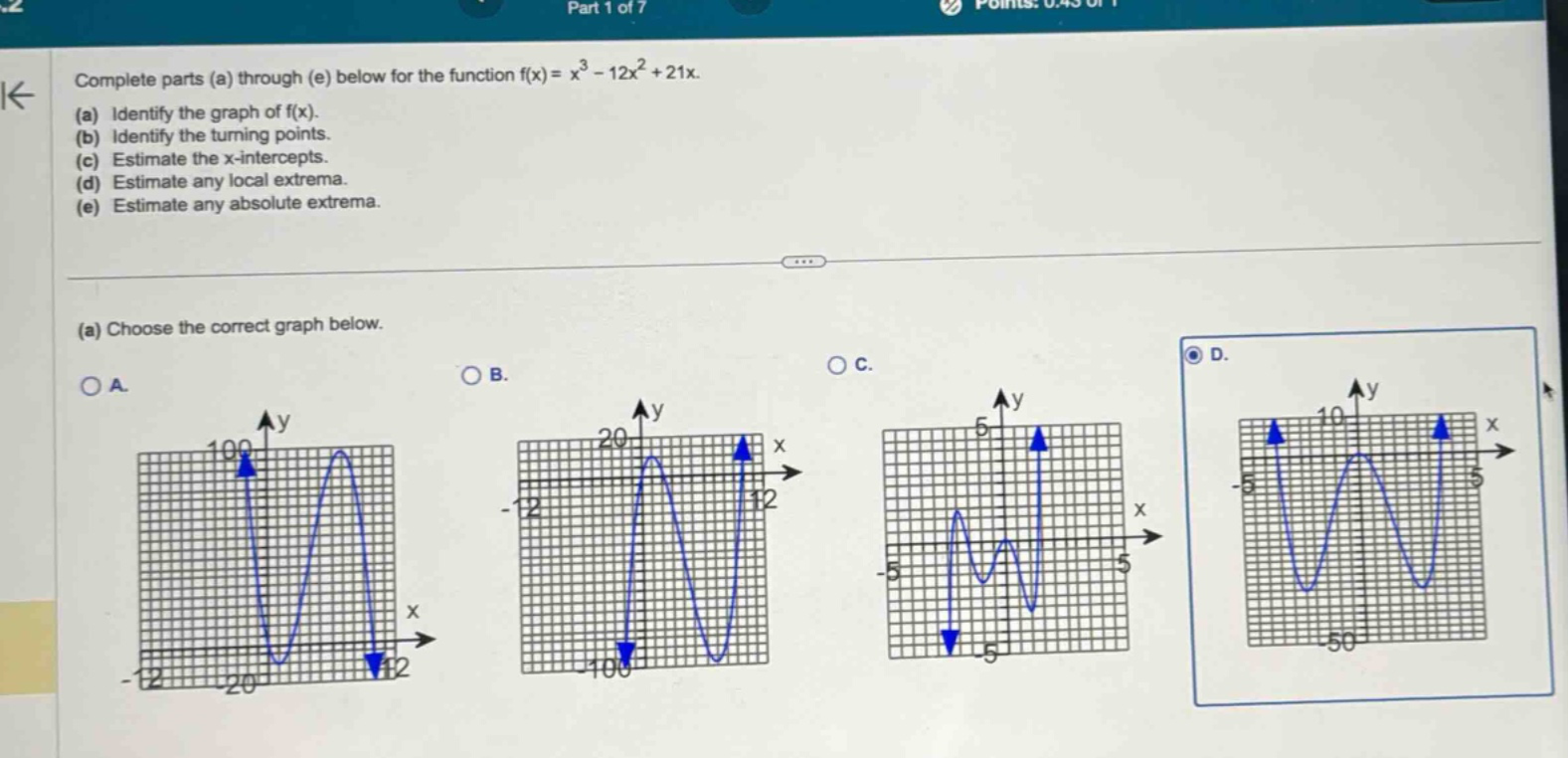
complete parts (a) through (e) below for the function f(x)=x³ - 12x² + 21x. (a) identify the graph of f(x). (b) identify the turning - points. (c) estimate the x - intercepts. (d) estimate any local extrema. (e) estimate any absolute extrema. (a) choose the correct graph below.
Answer
Explanation:
Step1: Find the derivative of the function
The derivative of $f(x)=x^{3}-12x^{2}+21x$ is $f^\prime(x)=3x^{2}-24x + 21$. Factor it: $f^\prime(x)=3(x^{2}-8x + 7)=3(x - 1)(x - 7)$.
Step2: Analyze end - behavior
As $x\to+\infty$, $y = f(x)\to+\infty$ since the leading coefficient of $f(x)=x^{3}-12x^{2}+21x$ (the coefficient of $x^{3}$) is positive. As $x\to-\infty$, $y=f(x)\to-\infty$.
Step3: Find the $y$-intercept
Set $x = 0$ in $f(x)$, then $f(0)=0$.
Step4: Analyze the graph based on critical points
The critical points are found by setting $f^\prime(x)=0$, so $x = 1$ and $x = 7$. $f(1)=1^{3}-12\times1^{2}+21\times1=1 - 12 + 21=10$. $f(7)=7^{3}-12\times7^{2}+21\times7=343-588 + 147=-98$.
(a) The function $y = f(x)$ is a cubic function with a positive leading coefficient. It has a $y$-intercept at $(0,0)$, a local maximum at $(1,10)$ and a local minimum at $(7,-98)$. The correct graph is D. (b) The turning points occur at the critical points. Set $f^\prime(x)=3x^{2}-24x + 21 = 0$. Solving $3(x - 1)(x - 7)=0$ gives $x = 1$ and $x = 7$. Substitute into $f(x)$: $f(1)=10$ and $f(7)=-98$. The turning points are $(1,10)$ and $(7,-98)$. (c) To find the $x$-intercepts, set $f(x)=x^{3}-12x^{2}+21x=x(x^{2}-12x + 21)=0$. Using the quadratic formula for $x^{2}-12x + 21=0$, $x=\frac{12\pm\sqrt{144 - 84}}{2}=\frac{12\pm\sqrt{60}}{2}=6\pm\sqrt{15}$. The $x$-intercepts are $x = 0,x=6+\sqrt{15}\approx9.87,x=6 - \sqrt{15}\approx2.13$. (d) We found that $f(1)=10$ is a local maximum and $f(7)=-98$ is a local minimum. So the local maximum is $10$ at $x = 1$ and the local minimum is $-98$ at $x = 7$. (e) Since the function is a cubic function with a positive leading coefficient, as $x\to\pm\infty$, $y\to\pm\infty$. There is no absolute maximum or minimum over the entire real - line.
Answer:
(a) D (b) $(1,10)$ and $(7,-98)$ (c) $x = 0,x\approx2.13,x\approx9.87$ (d) Local maximum: $10$ at $x = 1$; Local minimum: $-98$ at $x = 7$ (e) No absolute extrema