complete parts (a) through (e) below for the function f(x)=x³ - 3x² - 24x. (a) identify the graph of f(x)…
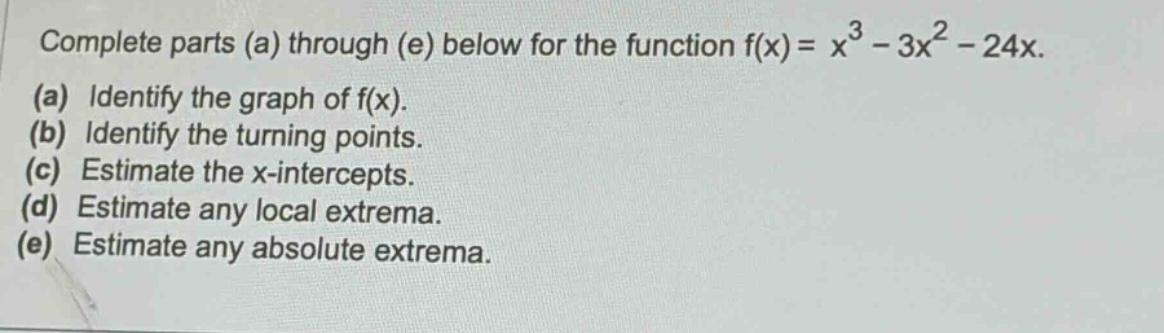
complete parts (a) through (e) below for the function f(x)=x³ - 3x² - 24x. (a) identify the graph of f(x). (b) identify the turning points. (c) estimate the x - intercepts. (d) estimate any local extrema. (e) estimate any absolute extrema.
Answer
Explanation:
Step1: Find the derivative
First, find the derivative of $f(x)=x^{3}-3x^{2}-24x$. Using the power - rule $(x^n)' = nx^{n - 1}$, we have $f'(x)=3x^{2}-6x - 24$.
Step2: Set the derivative equal to zero
Set $f'(x)=0$ to find the critical points. So, $3x^{2}-6x - 24 = 0$. Divide through by 3: $x^{2}-2x - 8=0$. Factor the quadratic equation: $(x - 4)(x+2)=0$. The critical points are $x=-2$ and $x = 4$.
Step3: Analyze the second - derivative
Find the second - derivative $f''(x)=6x - 6$.
- When $x=-2$, $f''(-2)=6\times(-2)-6=-12 - 6=-18<0$. So, $f(x)$ has a local maximum at $x=-2$.
- When $x = 4$, $f''(4)=6\times4-6=24 - 6 = 18>0$. So, $f(x)$ has a local minimum at $x = 4$.
Step4: Find the function values at critical and intercept points
- For $x$-intercepts, set $f(x)=0$. So, $x^{3}-3x^{2}-24x=x(x^{2}-3x - 24)=0$. One $x$-intercept is $x = 0$. Using the quadratic formula for $x^{2}-3x - 24=0$, $x=\frac{3\pm\sqrt{9+96}}{2}=\frac{3\pm\sqrt{105}}{2}$.
- $f(-2)=(-2)^{3}-3\times(-2)^{2}-24\times(-2)=-8 - 12 + 48=28$.
- $f(4)=4^{3}-3\times4^{2}-24\times4=64-48 - 96=-80$.
- As $x\to\pm\infty$, $y\to\pm\infty$ since the leading term of $f(x)$ is $x^{3}$. There are no absolute extrema.
(a) The graph of $y = f(x)$ is a cubic function with a positive leading coefficient ($x^{3}$), so it starts from negative infinity and ends at positive infinity. It has two turning points at $x=-2$ and $x = 4$. (b) The turning points are at $x=-2$ and $x = 4$. (c) The $x$-intercepts are $x = 0,x=\frac{3+\sqrt{105}}{2},x=\frac{3 - \sqrt{105}}{2}$. (d) The local maximum is $f(-2)=28$ and the local minimum is $f(4)=-80$. (e) There are no absolute extrema.
Answer:
(a) Cubic graph with positive leading - coefficient and two turning points. (b) $x=-2,x = 4$ (c) $x = 0,x=\frac{3+\sqrt{105}}{2},x=\frac{3 - \sqrt{105}}{2}$ (d) Local maximum: $f(-2)=28$, Local minimum: $f(4)=-80$ (e) No absolute extrema.