complete parts (a) through (e) below for the function f(x)=9 - 6x + x². (a) identify the graph of f(x). (b)…
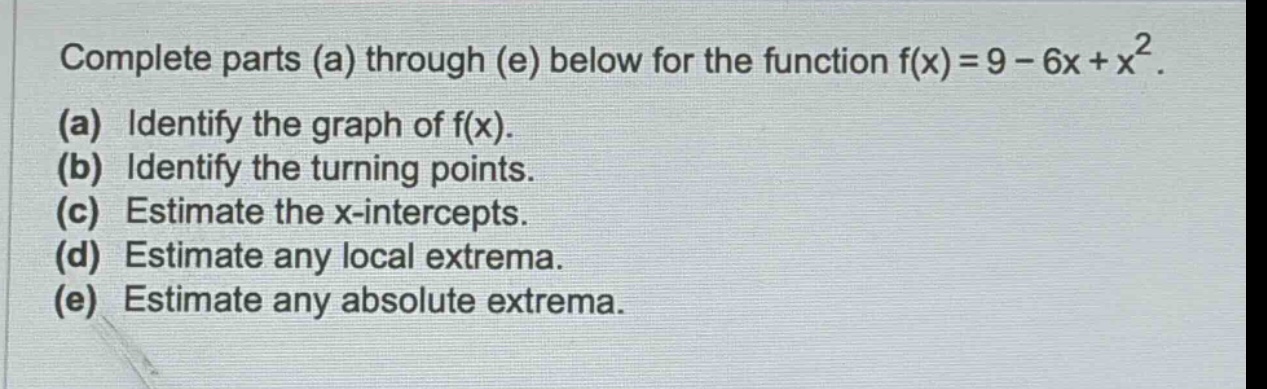
complete parts (a) through (e) below for the function f(x)=9 - 6x + x². (a) identify the graph of f(x). (b) identify the turning points. (c) estimate the x - intercepts. (d) estimate any local extrema. (e) estimate any absolute extrema.
Answer
Explanation:
Step1: Rewrite the function in vertex - form
The function (f(x)=x^{2}-6x + 9) can be rewritten as (f(x)=(x - 3)^{2}) using the formula (a^{2}-2ab+b^{2}=(a - b)^{2}) where (a=x) and (b = 3).
Step2: Analyze the graph
Since the coefficient of (x^{2}) is positive ((a = 1>0)), the graph is a parabola opening upwards.
Step3: Find the turning - point
For a parabola in the form (y=a(x - h)^{2}+k), the vertex (turning - point) is ((h,k)). For (y=(x - 3)^{2}), the turning - point is ((3,0)).
Step4: Find the x - intercepts
Set (y = 0), so ((x - 3)^{2}=0). Solving for (x), we get (x=3). So the x - intercept is (x = 3).
Step5: Find local and absolute extrema
Since the parabola opens upwards, the vertex ((3,0)) is both the local and absolute minimum. There is no local or absolute maximum.
Answer:
(a) The graph is a parabola opening upwards. (b) The turning - point is ((3,0)). (c) The x - intercept is (x = 3). (d) The local minimum is (0) at (x = 3), no local maximum. (e) The absolute minimum is (0) at (x = 3), no absolute maximum.