complete parts a through c for the given function. f(x)=x^(2/3)(x - 4) on -4,4 b. use the first derivative…
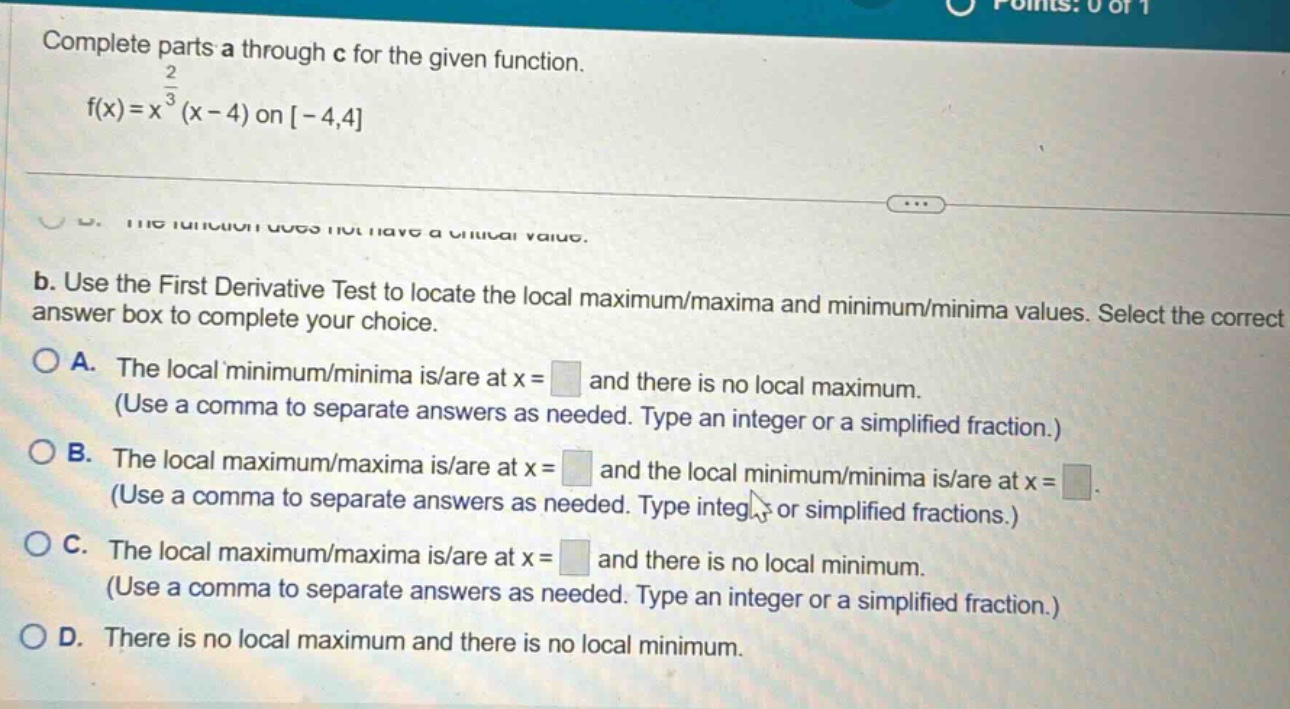
complete parts a through c for the given function. f(x)=x^(2/3)(x - 4) on -4,4 b. use the first derivative test to locate the local maximum/maxima and minimum/minima values. select the correct answer box to complete your choice. a. the local minimum/minima is/are at x = and there is no local maximum. (use a comma to separate answers as needed. type an integer or a simplified fraction.) b. the local maximum/maxima is/are at x = and the local minimum/minima is/are at x = (use a comma to separate answers as needed. type integer or simplified fractions.) c. the local maximum/maxima is/are at x = and there is no local minimum. (use a comma to separate answers as needed. type an integer or a simplified fraction.) d. there is no local maximum and there is no local minimum.
Answer
Explanation:
Step1: Expand the function
$f(x)=x^{\frac{2}{3}}(x - 4)=x^{\frac{5}{3}}-4x^{\frac{2}{3}}$
Step2: Find the first - derivative
Using the power rule $(x^n)^\prime=nx^{n - 1}$, we have $f^\prime(x)=\frac{5}{3}x^{\frac{2}{3}}-\frac{8}{3}x^{-\frac{1}{3}}=\frac{5x - 8}{3x^{\frac{1}{3}}}$
Step3: Find the critical points
Set $f^\prime(x) = 0$, then $\frac{5x - 8}{3x^{\frac{1}{3}}}=0$. The numerator gives $5x-8 = 0\Rightarrow x=\frac{8}{5}$, and the denominator gives $x = 0$ (where the derivative is undefined). So the critical points are $x = 0$ and $x=\frac{8}{5}$
Step4: Use the First - Derivative Test
- Consider the intervals $[-4,0)$, $(0,\frac{8}{5})$, and $(\frac{8}{5},4]$.
- For $x\in[-4,0)$, let's choose $x=-1$. Then $f^\prime(-1)=\frac{-5 - 8}{3(-1)^{\frac{1}{3}}}=\frac{-13}{-3}=\frac{13}{3}>0$.
- For $x\in(0,\frac{8}{5})$, let's choose $x = 1$. Then $f^\prime(1)=\frac{5 - 8}{3(1)^{\frac{1}{3}}}=-1<0$.
- For $x\in(\frac{8}{5},4]$, let's choose $x = 2$. Then $f^\prime(2)=\frac{10 - 8}{3(2)^{\frac{1}{3}}}=\frac{2}{3(2)^{\frac{1}{3}}}>0$.
Since $f(x)$ changes from increasing to decreasing at $x = 0$, $f(0)=0$ is a local maximum. Since $f(x)$ changes from decreasing to increasing at $x=\frac{8}{5}$, $f(\frac{8}{5})=(\frac{8}{5})^{\frac{2}{3}}(\frac{8}{5}-4)=(\frac{8}{5})^{\frac{2}{3}}(-\frac{12}{5})$ is a local minimum.
Answer:
B. The local maximum/maxima is/are at $x = 0$ and the local minimum/minima is/are at $x=\frac{8}{5}$