complete the table of values for ( f(x)=3^{x} ) and ( g(x)=3x + 5 ).\n\nboth ( f(x) ) and ( g(x) ) grow as (…
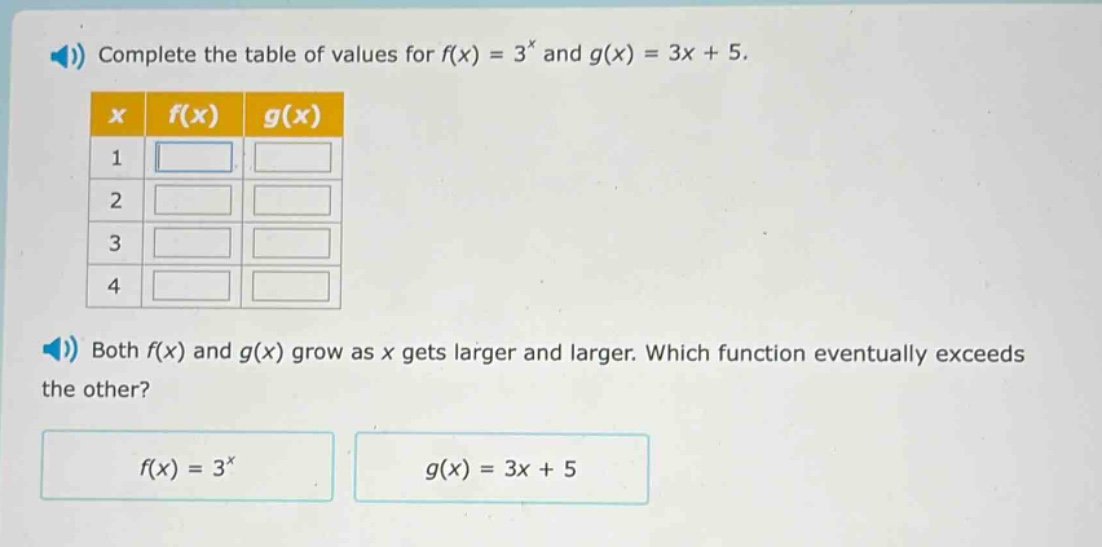
complete the table of values for ( f(x)=3^{x} ) and ( g(x)=3x + 5 ).\n\nboth ( f(x) ) and ( g(x) ) grow as ( x ) gets larger and larger. which function eventually exceeds the other?\n\n( f(x)=3^{x} )\n( g(x)=3x + 5 )
Answer
Explanation:
Step1: Calculate (f(x)) and (g(x)) for (x = 1)
For (f(x)=3^{x}), when (x = 1), (f(1)=3^{1}=3). For (g(x)=3x + 5), when (x = 1), (g(1)=3\times1+5=3 + 5=8).
Step2: Calculate (f(x)) and (g(x)) for (x = 2)
For (f(x)=3^{x}), when (x = 2), (f(2)=3^{2}=9). For (g(x)=3x + 5), when (x = 2), (g(2)=3\times2+5=6 + 5=11).
Step3: Calculate (f(x)) and (g(x)) for (x = 3)
For (f(x)=3^{x}), when (x = 3), (f(3)=3^{3}=27). For (g(x)=3x + 5), when (x = 3), (g(3)=3\times3+5=9 + 5=14).
Step4: Calculate (f(x)) and (g(x)) for (x = 4)
For (f(x)=3^{x}), when (x = 4), (f(4)=3^{4}=81). For (g(x)=3x + 5), when (x = 4), (g(4)=3\times4+5=12 + 5=17).
Step5: Determine which function exceeds the other
An exponential function (y = a^{x}(a>1)) has a faster - growing rate than a linear function (y=mx + b(m>0)) as (x\to+\infty). Here (f(x)=3^{x}) is an exponential function ((a = 3>1)) and (g(x)=3x + 5) is a linear function ((m = 3>0)).
Answer:
| (x) | (f(x)) | (g(x)) |
|---|---|---|
| (1) | (3) | (8) |
| (2) | (9) | (11) |
| (3) | (27) | (14) |
| (4) | (81) | (17) |
The function (f(x)=3^{x}) eventually exceeds the other function.