the compositions f(g(x)) and g(f(x)) of functions f and g are shown on the graph. which statements describe…
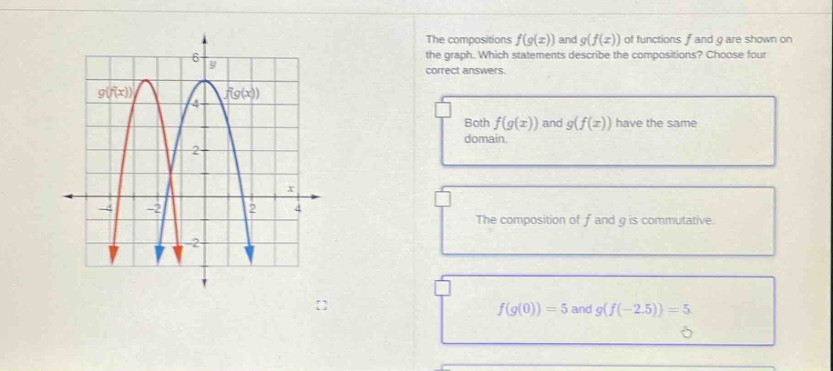
the compositions f(g(x)) and g(f(x)) of functions f and g are shown on the graph. which statements describe the compositions? choose four correct answers. both f(g(x)) and g(f(x)) have the same domain. the composition of f and g is commutative. f(g(0)) = 5 and g(f(-2.5)) = 5.
Answer
Explanation:
Step1: Analyze domain concept
The domain of a function - composition is the set of all input values for which the composition is defined. Looking at the graphs of (f(g(x))) and (g(f(x))), we can see that the set of (x) - values for which both functions are defined is the same. So, both (f(g(x))) and (g(f(x))) have the same domain.
Step2: Analyze commutativity
For two functions (f) and (g), if (f(g(x))=g(f(x))) for all (x) in the domain, then the composition is commutative. From the graph, (f(g(x))) and (g(f(x))) are different functions (they have different graphs), so the composition of (f) and (g) is not commutative.
Step3: Evaluate function - values
To find (f(g(0))), first find (g(0)) from the graph of (y = g(x)). Then use the value of (g(0)) as the input for (f). Similarly, for (g(f(-2.5))), first find (f(-2.5)) from the graph of (y = f(x)) and then use that value as the input for (g). From the graph, we can see that (f(g(0)) = 5) and (g(f(-2.5))=5).
Answer:
Both (f(g(x))) and (g(f(x))) have the same domain; (f(g(0)) = 5) and (g(f(-2.5)) = 5)