compute the sum\n∑(k = 36 to 87) (1/k - 1/(k + 1)).\nhint: write out the first few terms and the last few…
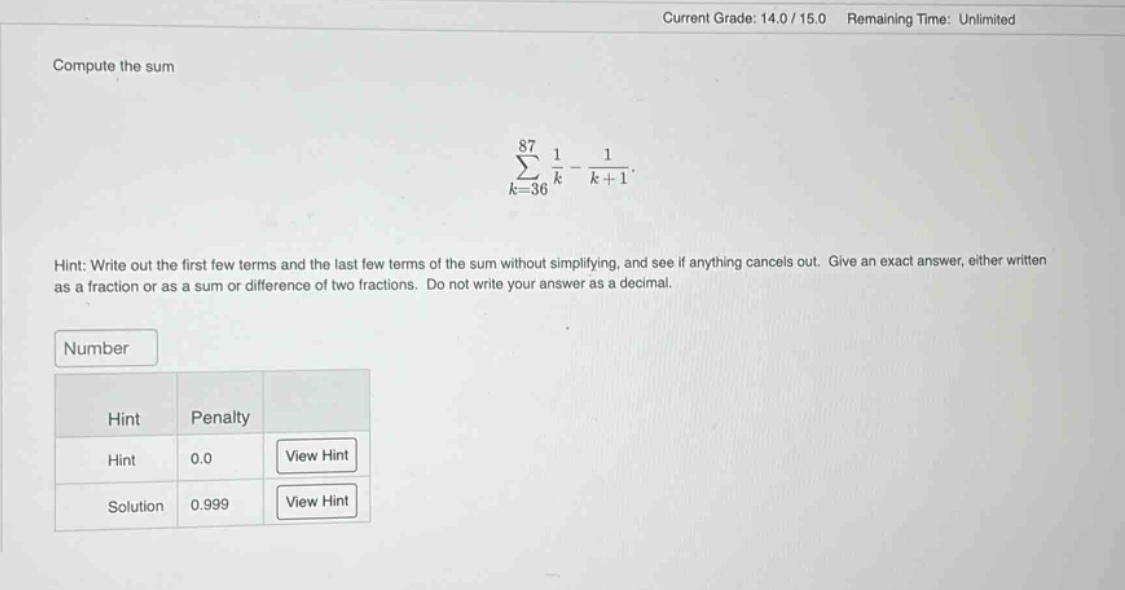
compute the sum\n∑(k = 36 to 87) (1/k - 1/(k + 1)).\nhint: write out the first few terms and the last few terms of the sum without simplifying, and see if anything cancels out. give an exact answer, either written as a fraction or as a sum or difference of two fractions. do not write your answer as a decimal.\nnumber\nhint penalty\nhint 0.0 view hint\nsolution 0.999 view hint
Answer
Explanation:
Step1: Expand the sum
Write out the first - few and last - few terms. When (k = 36), the term is (\frac{1}{36}-\frac{1}{37}); when (k = 37), the term is (\frac{1}{37}-\frac{1}{38}); (\cdots); when (k=87), the term is (\frac{1}{87}-\frac{1}{88}). So, (\sum_{k = 36}^{87}\left(\frac{1}{k}-\frac{1}{k + 1}\right)=\left(\frac{1}{36}-\frac{1}{37}\right)+\left(\frac{1}{37}-\frac{1}{38}\right)+\cdots+\left(\frac{1}{87}-\frac{1}{88}\right))
Step2: Observe the cancellation
Notice that most terms cancel out. The (-\frac{1}{37}) and (\frac{1}{37}), (-\frac{1}{38}) and (\frac{1}{38}), (\cdots), (-\frac{1}{87}) and (\frac{1}{87}) cancel. We are left with (\frac{1}{36}-\frac{1}{88})
Step3: Find a common denominator
Find a common denominator for (\frac{1}{36}-\frac{1}{88}). The common denominator of 36 and 88 is (792) (since (36\times22 = 792) and (88\times9=792)). (\frac{1}{36}-\frac{1}{88}=\frac{22}{792}-\frac{9}{792})
Step4: Subtract the fractions
Subtract the fractions with the common denominator. (\frac{22 - 9}{792}=\frac{13}{792})
Answer:
(\frac{13}{792})