confirm that the integral test can be applied to the series.\n\\(\\sum_{n = 1}^{\\infty}e^{-n}\\)\nevaluate…
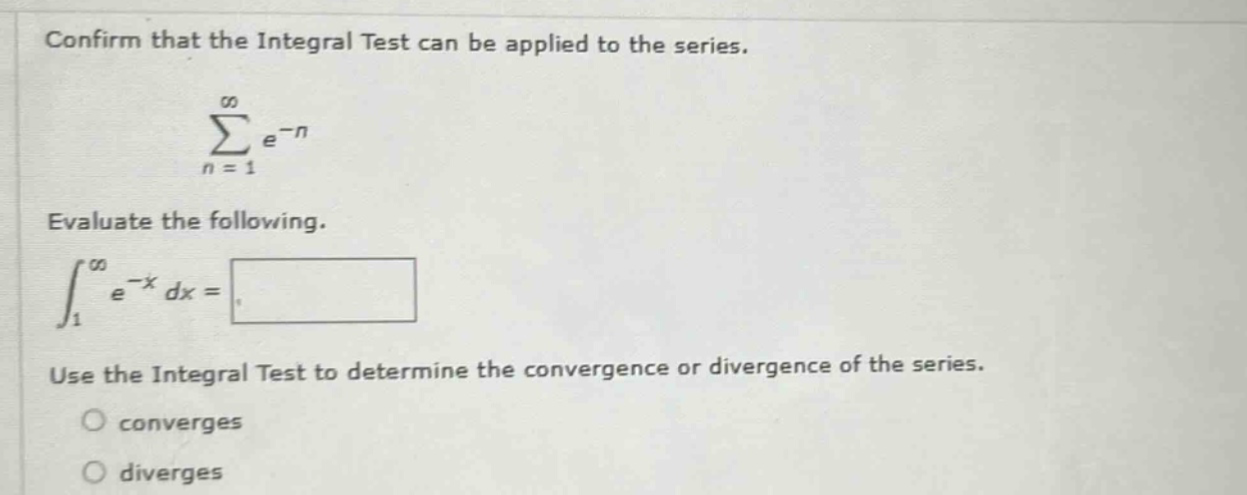
confirm that the integral test can be applied to the series.\n\\(\\sum_{n = 1}^{\\infty}e^{-n}\\)\nevaluate the following.\n\\(\\int_{1}^{\\infty}e^{-x}dx=)\nuse the integral test to determine the convergence or divergence of the series.\nconverges\ndiverges
Answer
Explanation:
Step1: Recall integral - test conditions
For the series $\sum_{n = 1}^{\infty}f(n)$, if $f(x)$ is positive, continuous and decreasing for $x\geq1$, the integral test can be applied. Let $f(x)=e^{-x}$. The function $y = e^{-x}=\frac{1}{e^{x}}$ is positive for all $x\geq1$, continuous for all real - valued $x$ (since it is an exponential function), and its derivative $f^\prime(x)=-e^{-x}<0$ for all $x\geq1$, so it is decreasing. Thus, the integral test can be applied.
Step2: Evaluate the improper integral
We want to evaluate $\int_{1}^{\infty}e^{-x}dx$. First, find the antiderivative of $e^{-x}$. The antiderivative of $e^{-x}$ is $-e^{-x}$. Then, use the formula for improper integrals: $\int_{1}^{\infty}e^{-x}dx=\lim_{b\rightarrow\infty}\int_{1}^{b}e^{-x}dx$. [ \begin{align*} \lim_{b\rightarrow\infty}\int_{1}^{b}e^{-x}dx&=\lim_{b\rightarrow\infty}\left[-e^{-x}\right]{1}^{b}\ &=\lim{b\rightarrow\infty}\left(-e^{-b}+e^{-1}\right) \end{align*} ] Since $\lim_{b\rightarrow\infty}e^{-b}=\lim_{b\rightarrow\infty}\frac{1}{e^{b}} = 0$, we have $\lim_{b\rightarrow\infty}\left(-e^{-b}+e^{-1}\right)=\frac{1}{e}$.
Step3: Determine convergence of the series
By the integral test, if $\int_{1}^{\infty}f(x)dx$ converges, then the series $\sum_{n = 1}^{\infty}f(n)$ converges. Since $\int_{1}^{\infty}e^{-x}dx=\frac{1}{e}$ (a finite value), the series $\sum_{n = 1}^{\infty}e^{-n}$ converges.
Answer:
$\int_{1}^{\infty}e^{-x}dx=\frac{1}{e}$ converges