consider f(x) = 8(x - 1)/(x²+2x - 3). which statements describe the existence of vertical asymptotes at x =…
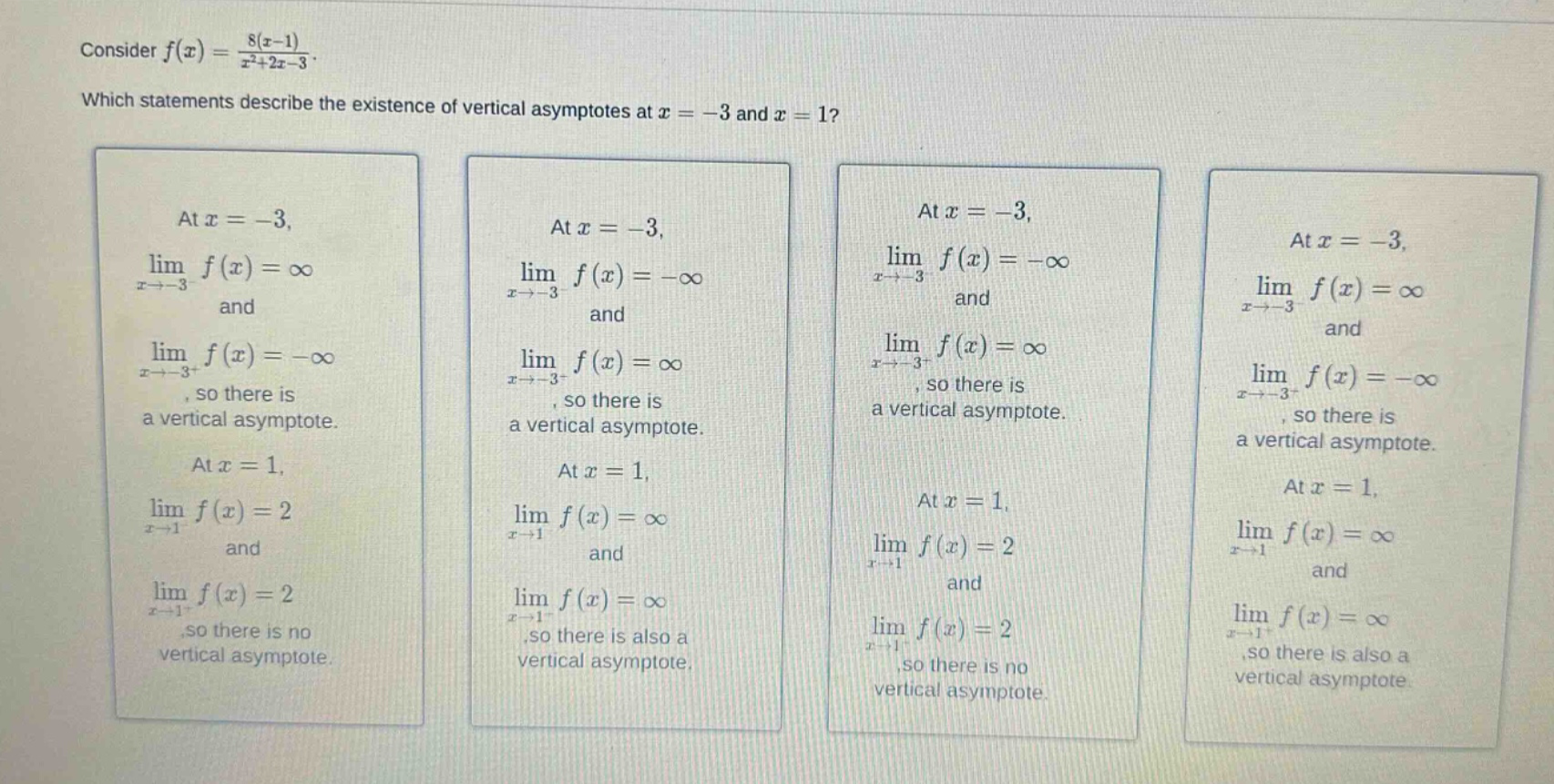
consider f(x) = 8(x - 1)/(x²+2x - 3). which statements describe the existence of vertical asymptotes at x = -3 and x = 1? at x = -3, lim x→-3- f(x) = ∞ and lim x→-3+ f(x) = -∞, so there is a vertical asymptote. at x = 1, lim x→1 f(x) = 2 and lim x→1+ f(x) = 2, so there is no vertical asymptote. at x = -3, lim x→-3- f(x) = -∞ and lim x→-3+ f(x) = ∞, so there is a vertical asymptote. at x = 1, lim x→1 f(x) = ∞ and lim x→1+ f(x) = ∞, so there is also a vertical asymptote. at x = -3, lim x→-3- f(x) = -∞ and lim x→-3+ f(x) = ∞, so there is a vertical asymptote. at x = 1, lim x→1 f(x) = 2 and lim x→1+ f(x) = 2, so there is no vertical asymptote. at x = -3, lim x→-3- f(x) = ∞ and lim x→-3+ f(x) = -∞, so there is a vertical asymptote. at x = 1, lim x→1 f(x) = ∞ and lim x→1+ f(x) = ∞, so there is also a vertical asymptote.
Answer
Explanation:
Step1: Factor the denominator
First, factor the denominator $x^{2}+2x - 3=(x + 3)(x - 1)$. So, $f(x)=\frac{8(x - 1)}{(x + 3)(x - 1)}$.
Step2: Simplify the function
Cancel out the common - factor $(x - 1)$ (for $x\neq1$), and we get $f(x)=\frac{8}{x + 3},x\neq1$.
Step3: Analyze the limit as $x\to - 3$
As $x\to - 3^{-}$, let $x=-3 - h$ where $h\to0^{+}$. Then $f(x)=\frac{8}{-3 - h+3}=\frac{8}{-h}\to-\infty$. As $x\to - 3^{+}$, let $x=-3 + h$ where $h\to0^{+}$. Then $f(x)=\frac{8}{-3 + h+3}=\frac{8}{h}\to\infty$. So, there is a vertical asymptote at $x=-3$.
Step4: Analyze the limit as $x\to1$
Since $f(x)=\frac{8}{x + 3}$ for $x\neq1$, $\lim_{x\to1}f(x)=\frac{8}{1 + 3}=2$. So, there is no vertical asymptote at $x = 1$.
Answer:
At $x=-3$, $\lim_{x\to - 3^{-}}f(x)=-\infty$ and $\lim_{x\to - 3^{+}}f(x)=\infty$, so there is a vertical asymptote. At $x = 1$, $\lim_{x\to1}f(x)=2$ and $\lim_{x\to1^{+}}f(x)=2$, so there is no vertical asymptote.