consider the accompanying graphs of y = 5x + 6 and y = ln x. determine the (a) minimum vertical distance and…
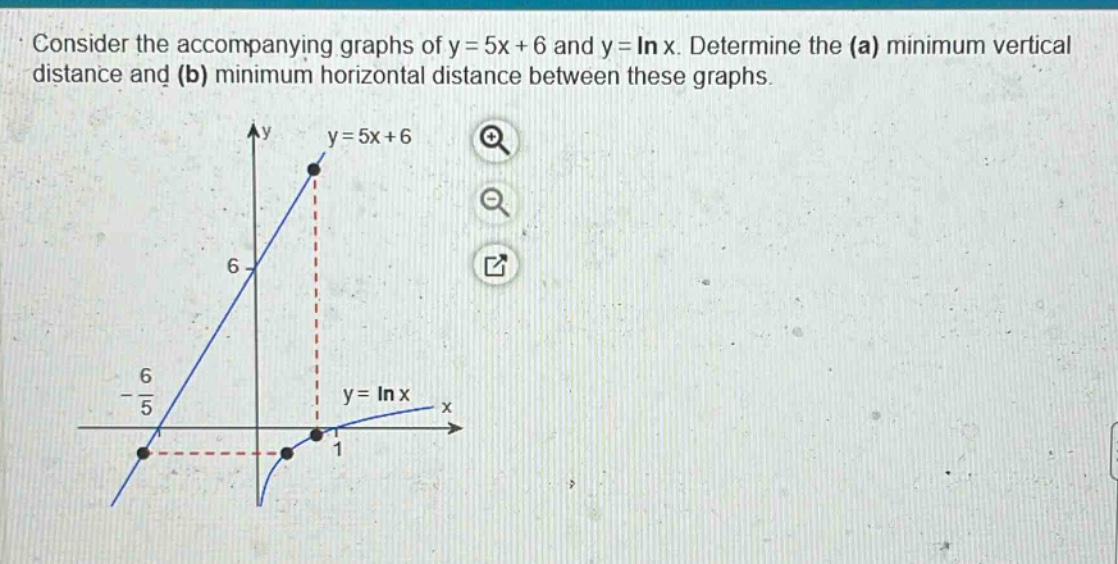
consider the accompanying graphs of y = 5x + 6 and y = ln x. determine the (a) minimum vertical distance and (b) minimum horizontal distance between these graphs.
Answer
Explanation:
Step1: Define vertical - distance function
Let (d_v(x)=(5x + 6)-\ln x), (x>0). To find its minimum, we take the derivative. The derivative (d_v^\prime(x)=5-\frac{1}{x}).
Step2: Find critical points
Set (d_v^\prime(x) = 0), then (5-\frac{1}{x}=0). Solving for (x) gives (x=\frac{1}{5}).
Step3: Check the second - derivative
The second - derivative (d_v^{\prime\prime}(x)=\frac{1}{x^{2}}). When (x = \frac{1}{5}), (d_v^{\prime\prime}(\frac{1}{5}) = 25>0), so (x=\frac{1}{5}) is a point of minimum.
Step4: Calculate the minimum vertical distance
Substitute (x=\frac{1}{5}) into (d_v(x)): (d_v(\frac{1}{5})=5\times\frac{1}{5}+6-\ln\frac{1}{5}=1 + 6+\ln5=7+\ln5).
Step5: Define horizontal - distance function
Let the (y) - value be (y). Then from (y = 5x_1+6) we have (x_1=\frac{y - 6}{5}), and from (y=\ln x_2) we have (x_2 = e^y). The horizontal distance (d_h(y)=e^y-\frac{y - 6}{5}).
Step6: Take the derivative of the horizontal - distance function
(d_h^\prime(y)=e^y-\frac{1}{5}).
Step7: Find critical points of the horizontal - distance function
Set (d_h^\prime(y)=0), then (e^y=\frac{1}{5}), so (y=-\ln5).
Step8: Check the second - derivative of the horizontal - distance function
The second - derivative (d_h^{\prime\prime}(y)=e^y). When (y = -\ln5), (d_h^{\prime\prime}(-\ln5)=\frac{1}{5}>0), so (y = -\ln5) is a point of minimum.
Step9: Calculate the minimum horizontal distance
Substitute (y = -\ln5) into (d_h(y)): (d_h(-\ln5)=e^{-\ln5}-\frac{-\ln5 - 6}{5}=\frac{1}{5}+\frac{\ln5 + 6}{5}=\frac{1+\ln5 + 6}{5}=\frac{7+\ln5}{5}).
Answer:
(a) (7+\ln5) (b) (\frac{7+\ln5}{5})