consider the equation below. (if an answer does not exist, enter dne.) f(x) = x / (x^2 + 9) (a) find the…
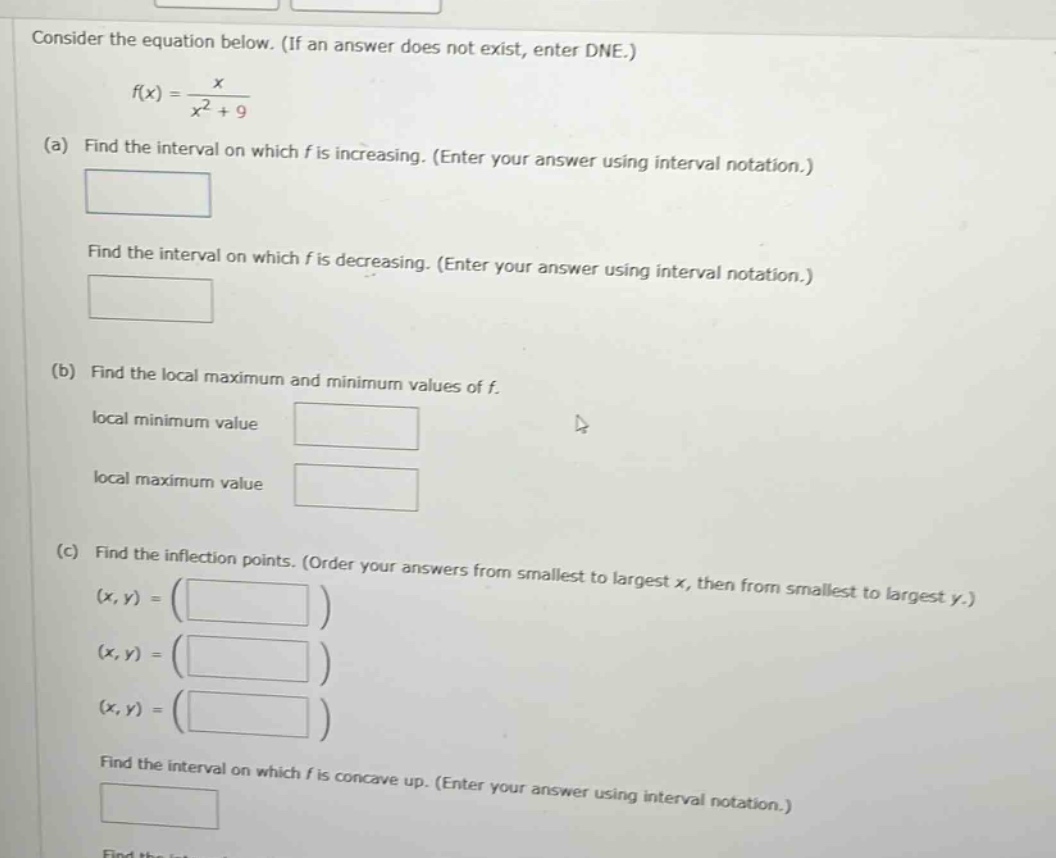
consider the equation below. (if an answer does not exist, enter dne.) f(x) = x / (x^2 + 9) (a) find the interval on which f is increasing. (enter your answer using interval notation.) find the interval on which f is decreasing. (enter your answer using interval notation.) (b) find the local maximum and minimum values of f. local minimum value local maximum value (c) find the inflection points. (order your answers from smallest to largest x, then from smallest to largest y.) (x, y) = ( ) (x, y) = ( ) (x, y) = ( ) find the interval on which f is concave up. (enter your answer using interval notation.)
Answer
Explanation:
Step1: Find the first - derivative
Use the quotient rule. If $f(x)=\frac{u}{v}$ where $u = x$ and $v=x^{2}+9$, then $u'=1$ and $v' = 2x$. The quotient rule states that $f'(x)=\frac{u'v - uv'}{v^{2}}$. So $f'(x)=\frac{(x^{2}+9)\times1-x\times(2x)}{(x^{2}+9)^{2}}=\frac{x^{2}+9 - 2x^{2}}{(x^{2}+9)^{2}}=\frac{9 - x^{2}}{(x^{2}+9)^{2}}$.
Step2: Find critical points
Set $f'(x)=0$. Then $\frac{9 - x^{2}}{(x^{2}+9)^{2}}=0$. Since $(x^{2}+9)^{2}>0$ for all real $x$, we solve $9 - x^{2}=0$. Factoring gives $(3 - x)(3 + x)=0$, so $x=-3$ or $x = 3$.
Step3: Determine intervals of increase and decrease
Test intervals $(-\infty,-3)$, $(-3,3)$ and $(3,\infty)$. For $x<-3$, let $x=-4$. Then $f'(-4)=\frac{9-16}{(16 + 9)^{2}}=\frac{-7}{(25)^{2}}<0$, so $f(x)$ is decreasing on $(-\infty,-3)$. For $-3<x<3$, let $x = 0$. Then $f'(0)=\frac{9-0}{(0 + 9)^{2}}=\frac{1}{9}>0$, so $f(x)$ is increasing on $(-3,3)$. For $x>3$, let $x = 4$. Then $f'(4)=\frac{9 - 16}{(16+9)^{2}}=\frac{-7}{(25)^{2}}<0$, so $f(x)$ is decreasing on $(3,\infty)$.
Step4: Find local maximum and minimum
Since $f(x)$ changes from decreasing to increasing at $x=-3$, $f(-3)=\frac{-3}{9 + 9}=-\frac{1}{6}$ is a local minimum. Since $f(x)$ changes from increasing to decreasing at $x = 3$, $f(3)=\frac{3}{9+9}=\frac{1}{6}$ is a local maximum.
Step5: Find the second - derivative
Use the quotient rule on $f'(x)=\frac{9 - x^{2}}{(x^{2}+9)^{2}}$. Let $u = 9 - x^{2}$, $u'=-2x$, $v=(x^{2}+9)^{2}$, and $v'=2(x^{2}+9)\times2x = 4x(x^{2}+9)$. Then $f''(x)=\frac{-2x(x^{2}+9)^{2}-(9 - x^{2})\times4x(x^{2}+9)}{(x^{2}+9)^{4}}=\frac{-2x(x^{2}+9)-4x(9 - x^{2})}{(x^{2}+9)^{3}}=\frac{-2x^{3}-18x-36x + 4x^{3}}{(x^{2}+9)^{3}}=\frac{2x^{3}-54x}{(x^{2}+9)^{3}}=\frac{2x(x^{2}-27)}{(x^{2}+9)^{3}}$.
Step6: Find inflection points
Set $f''(x)=0$. Then $\frac{2x(x^{2}-27)}{(x^{2}+9)^{3}}=0$. Since $(x^{2}+9)^{3}>0$ for all real $x$, we solve $2x(x^{2}-27)=0$. Factoring gives $2x(x - 3\sqrt{3})(x+3\sqrt{3})=0$. So $x=-3\sqrt{3},0,3\sqrt{3}$. $f(-3\sqrt{3})=\frac{-3\sqrt{3}}{27 + 9}=-\frac{\sqrt{3}}{12}$, $f(0)=0$, $f(3\sqrt{3})=\frac{3\sqrt{3}}{27 + 9}=\frac{\sqrt{3}}{12}$. The inflection points are $(-3\sqrt{3},-\frac{\sqrt{3}}{12})$, $(0,0)$ and $(3\sqrt{3},\frac{\sqrt{3}}{12})$. Test intervals for concavity: For $x<-3\sqrt{3}$, let $x=-6$. Then $f''(-6)=\frac{2\times(-6)\times(36 - 27)}{(36 + 9)^{3}}=\frac{-12\times9}{(45)^{3}}<0$. For $-3\sqrt{3}<x<0$, let $x=-3$. Then $f''(-3)=\frac{2\times(-3)\times(9 - 27)}{(9 + 9)^{3}}=\frac{-6\times(-18)}{(18)^{3}}>0$. For $0<x<3\sqrt{3}$, let $x = 3$. Then $f''(3)=\frac{2\times3\times(9 - 27)}{(9 + 9)^{3}}=\frac{6\times(-18)}{(18)^{3}}<0$. For $x>3\sqrt{3}$, let $x = 6$. Then $f''(6)=\frac{2\times6\times(36 - 27)}{(36 + 9)^{3}}=\frac{12\times9}{(45)^{3}}>0$. $f(x)$ is concave up on $(-3\sqrt{3},0)\cup(3\sqrt{3},\infty)$.
Answer:
(a) Increasing interval: $(-3,3)$ Decreasing interval: $(-\infty,-3)\cup(3,\infty)$ (b) Local minimum value: $-\frac{1}{6}$ Local maximum value: $\frac{1}{6}$ (c) Inflection points: $(-3\sqrt{3},-\frac{\sqrt{3}}{12})$, $(0,0)$, $(3\sqrt{3},\frac{\sqrt{3}}{12})$ Concave - up interval: $(-3\sqrt{3},0)\cup(3\sqrt{3},\infty)$