(a) consider the error in using the approximation e^(-x)≈1 - x on the interval -1,1. reasoning informally…
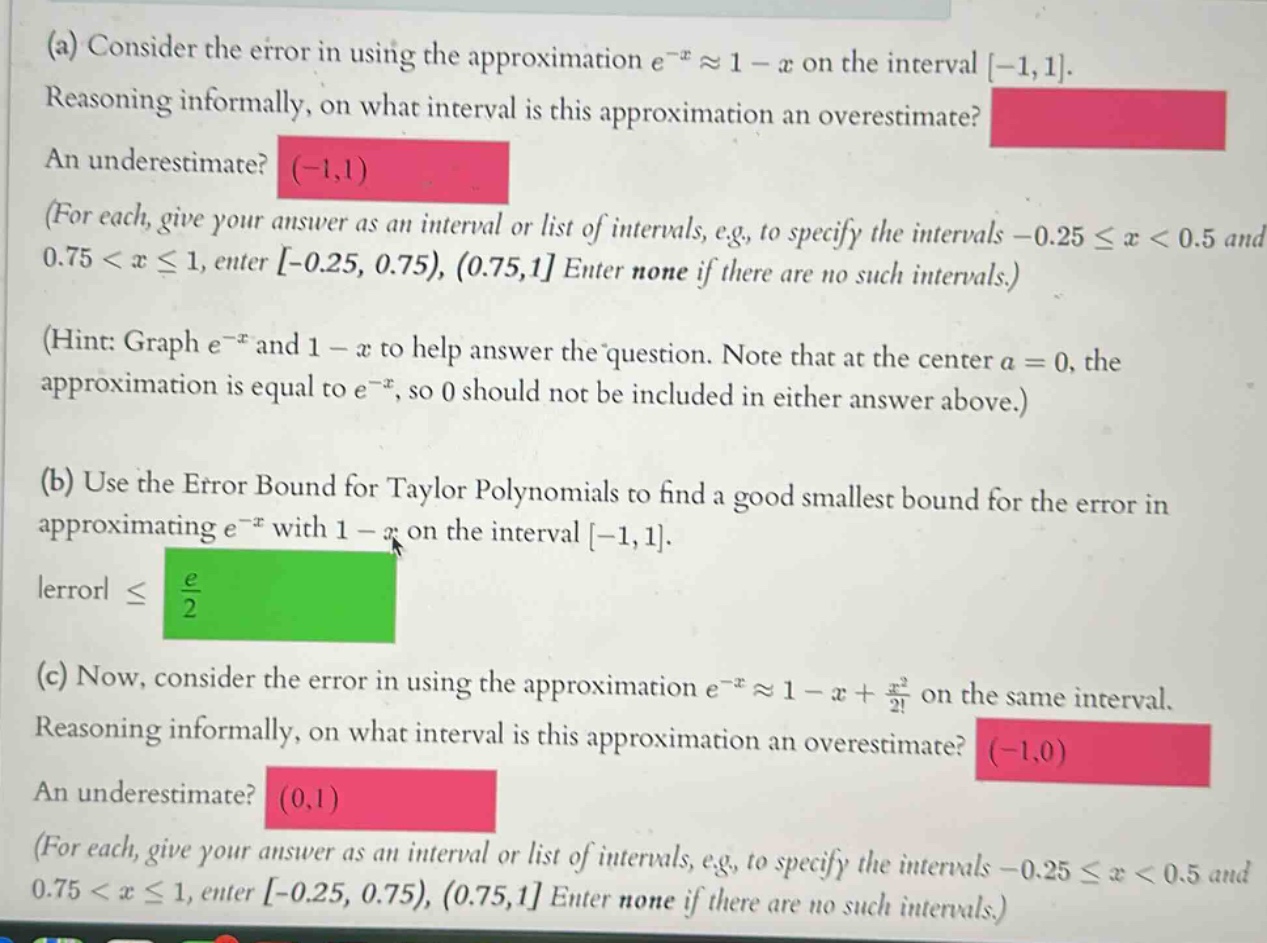
(a) consider the error in using the approximation e^(-x)≈1 - x on the interval -1,1. reasoning informally, on what interval is this approximation an overestimate? an underestimate? (-1,1) (for each, give your answer as an interval or list of intervals, e.g., to specify the intervals -0.25≤x<0.5 and 0.75<x≤1, enter -0.25, 0.75), (0.75,1 enter none if there are no such intervals.) (hint: graph e^(-x) and 1 - x to help answer the question. note that at the center a = 0, the approximation is equal to e^(-x), so 0 should not be included in either answer above.) (b) use the error bound for taylor polynomials to find a good smallest bound for the error in approximating e^(-x) with 1 - x on the interval -1,1. |error|≤ e/2 (c) now, consider the error in using the approximation e^(-x)≈1 - x + x^2/2! on the same interval. reasoning informally, on what interval is this approximation an overestimate? (-1,0) an underestimate? (0,1) (for each, give your answer as an interval or list of intervals, e.g., to specify the intervals -0.25≤x<0.5 and 0.75<x≤1, enter -0.25, 0.75), (0.75,1 enter none if there are no such intervals.)
Answer
Explanation:
Step1: Analyze $e^{-x}\approx1 - x$
The Taylor - series expansion of $e^{-x}=1 - x+\frac{x^{2}}{2!}-\frac{x^{3}}{3!}+\cdots$. Let $f(x)=e^{-x}$ and $g(x)=1 - x$. The difference $h(x)=f(x)-g(x)=\frac{x^{2}}{2!}-\frac{x^{3}}{3!}+\cdots$. When $x\in(- 1,0)$, $h(x)>0$ (since the first non - zero term $\frac{x^{2}}{2!}>0$ for $x\neq0$), so $e^{-x}>1 - x$ and $1 - x$ is an underestimate. When $x\in(0,1)$, $h(x)>0$, so $e^{-x}>1 - x$ and $1 - x$ is an underestimate.
Step2: Use Taylor error bound for $e^{-x}\approx1 - x$
The Taylor polynomial of degree $n$ for $f(x)=e^{-x}$ centered at $a = 0$ is $P_n(x)=\sum_{k = 0}^{n}\frac{f^{(k)}(0)}{k!}x^{k}$. Here $P_1(x)=1 - x$. The error bound for Taylor polynomials is $|R_n(x)|\leq\frac{M}{(n + 1)!}|x - a|^{n+1}$, where $M$ is an upper bound for $|f^{(n + 1)}(t)|$ on the interval between $a$ and $x$. For $f(x)=e^{-x}$, $f^{(n)}(x)=(-1)^{n}e^{-x}$, and on $[-1,1]$, $|f^{(2)}(t)|=e^{-t}\leq e$ for $t\in[-1,1]$. With $n = 1$, $a = 0$, and $|x|\leq1$, the error bound $|R_1(x)|\leq\frac{e}{2!}|x|^{2}\leq\frac{e}{2}$ for $x\in[-1,1]$.
Step3: Analyze $e^{-x}\approx1 - x+\frac{x^{2}}{2}$
Let $y(x)=e^{-x}-(1 - x+\frac{x^{2}}{2})=-\frac{x^{3}}{3!}+\frac{x^{4}}{4!}-\cdots$. When $x\in(-1,0)$, $y(x)<0$, so $e^{-x}<1 - x+\frac{x^{2}}{2}$ and $1 - x+\frac{x^{2}}{2}$ is an overestimate. When $x\in(0,1)$, $y(x)>0$, so $e^{-x}>1 - x+\frac{x^{2}}{2}$ and $1 - x+\frac{x^{2}}{2}$ is an underestimate.
Answer:
(a) Overestimate: none; Underestimate: $(-1,0)\cup(0,1)$ (b) $\frac{e}{2}$ (c) Overestimate: $(-1,0)$; Underestimate: $(0,1)$