consider the family of functions f(x)=1/x^p, where p is a real number. for what values of p does the…
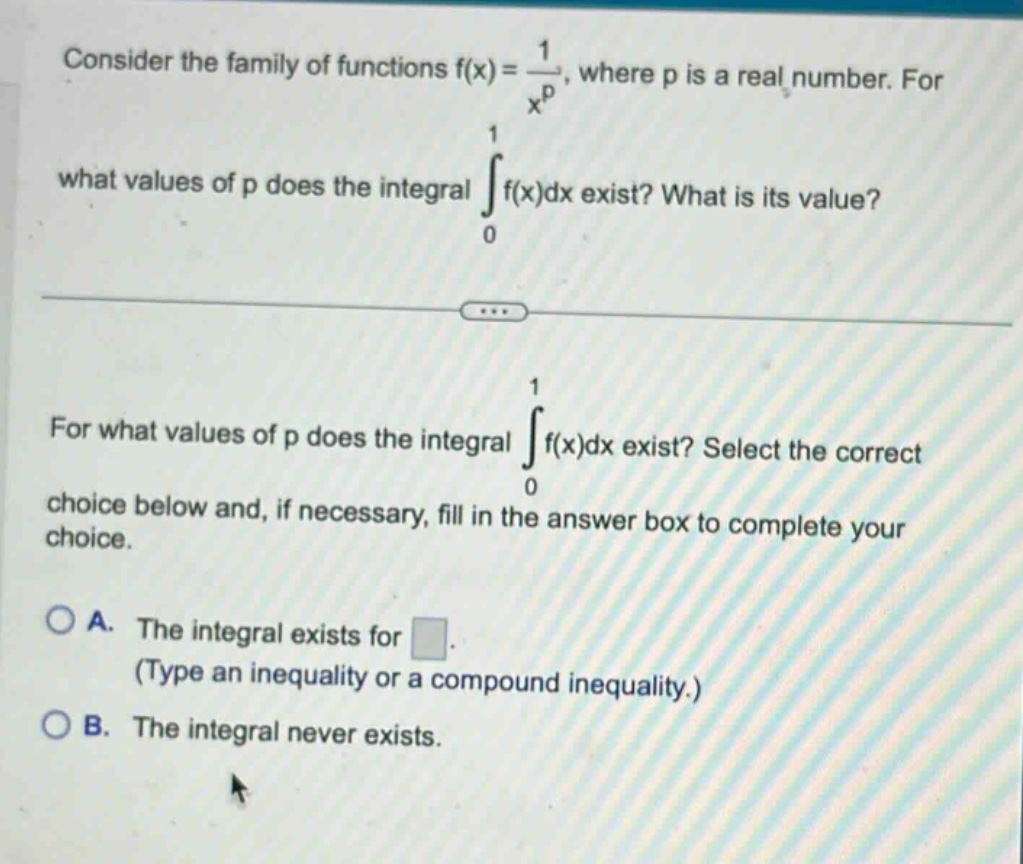
consider the family of functions f(x)=1/x^p, where p is a real number. for what values of p does the integral ∫(from 0 to 1)f(x)dx exist? what is its value? for what values of p does the integral ∫(from 0 to 1)f(x)dx exist? select the correct choice below and, if necessary, fill in the answer box to complete your choice. a. the integral exists for . (type an inequality or a compound inequality.) b. the integral never exists.
Answer
Explanation:
Step1: Recall the power - rule for integration
The antiderivative of $x^{-p}$ is $\frac{x^{-p + 1}}{-p+1}+C$ for $p\neq1$ and $\ln|x|+C$ for $p = 1$. We are dealing with the improper integral $\int_{0}^{1}\frac{1}{x^{p}}dx=\lim_{a\rightarrow0^{+}}\int_{a}^{1}x^{-p}dx$.
Step2: Case 1: $p\neq1$
Calculate $\lim_{a\rightarrow0^{+}}\int_{a}^{1}x^{-p}dx=\lim_{a\rightarrow0^{+}}\left[\frac{x^{-p + 1}}{-p + 1}\right]{a}^{1}=\lim{a\rightarrow0^{+}}\left(\frac{1}{1 - p}-\frac{a^{1 - p}}{1 - p}\right)$. This limit exists when $1-p>0$, i.e., $p<1$.
Step3: Case 2: $p = 1$
Calculate $\lim_{a\rightarrow0^{+}}\int_{a}^{1}\frac{1}{x}dx=\lim_{a\rightarrow0^{+}}[\ln x]{a}^{1}=\lim{a\rightarrow0^{+}}(0-\ln a)=\infty$.
Answer:
A. The integral exists for $p<1$