consider the following. (if an answer does not exist, enter dne.) f(x) = (x^2 - 16)/(x - 5) (a) find the…
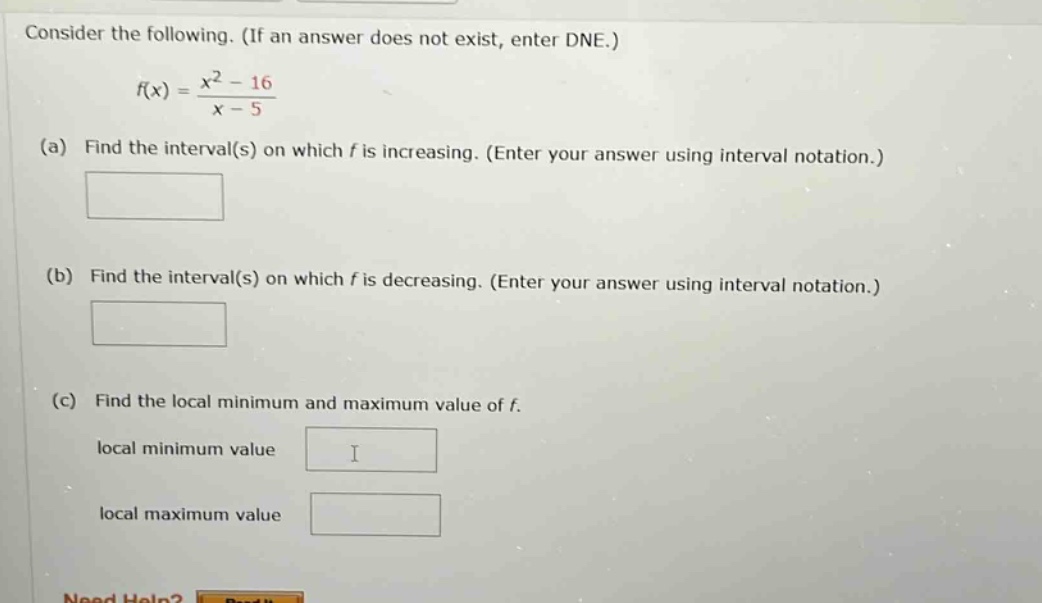
consider the following. (if an answer does not exist, enter dne.) f(x) = (x^2 - 16)/(x - 5) (a) find the interval(s) on which f is increasing. (enter your answer using interval notation.) (b) find the interval(s) on which f is decreasing. (enter your answer using interval notation.) (c) find the local minimum and maximum value of f. local minimum value local maximum value
Answer
Explanation:
Step1: Find the derivative of $f(x)$
Use the quotient - rule. If $f(x)=\frac{u(x)}{v(x)}$ where $u(x)=x^{2}-16$ and $v(x)=x - 5$, then $u'(x)=2x$ and $v'(x)=1$. The quotient - rule states that $f'(x)=\frac{u'(x)v(x)-u(x)v'(x)}{v^{2}(x)}$. So $f'(x)=\frac{2x(x - 5)-(x^{2}-16)\times1}{(x - 5)^{2}}=\frac{2x^{2}-10x-x^{2}+16}{(x - 5)^{2}}=\frac{x^{2}-10x + 16}{(x - 5)^{2}}=\frac{(x - 2)(x - 8)}{(x - 5)^{2}}$.
Step2: Find the critical points
Set $f'(x)=0$. Since $f'(x)=\frac{(x - 2)(x - 8)}{(x - 5)^{2}}$, then $(x - 2)(x - 8)=0$ (the denominator $(x - 5)^{2}\neq0$ when finding critical points from the numerator). So the critical points are $x = 2$ and $x = 8$. The function is undefined at $x = 5$.
Step3: Test the intervals
We have the intervals $(-\infty,2)$, $(2,5)$, $(5,8)$ and $(8,\infty)$.
- For the interval $(-\infty,2)$, choose a test - point, say $x = 1$. Then $f'(1)=\frac{(1 - 2)(1 - 8)}{(1 - 5)^{2}}=\frac{(-1)\times(-7)}{16}=\frac{7}{16}>0$. So $f(x)$ is increasing on $(-\infty,2)$.
- For the interval $(2,5)$, choose $x = 3$. Then $f'(3)=\frac{(3 - 2)(3 - 8)}{(3 - 5)^{2}}=\frac{1\times(-5)}{4}=-\frac{5}{4}<0$. So $f(x)$ is decreasing on $(2,5)$.
- For the interval $(5,8)$, choose $x = 6$. Then $f'(6)=\frac{(6 - 2)(6 - 8)}{(6 - 5)^{2}}=\frac{4\times(-2)}{1}=-8<0$. So $f(x)$ is decreasing on $(5,8)$.
- For the interval $(8,\infty)$, choose $x = 9$. Then $f'(9)=\frac{(9 - 2)(9 - 8)}{(9 - 5)^{2}}=\frac{7\times1}{16}=\frac{7}{16}>0$. So $f(x)$ is increasing on $(8,\infty)$.
Step4: Find local extrema
Since $f(x)$ changes from increasing to decreasing at $x = 2$, $f(2)=\frac{2^{2}-16}{2 - 5}=\frac{4 - 16}{-3}=4$ is a local maximum. Since $f(x)$ changes from decreasing to increasing at $x = 8$, $f(8)=\frac{8^{2}-16}{8 - 5}=\frac{64 - 16}{3}=16$ is a local minimum.
Answer:
(a) $(-\infty,2)\cup(8,\infty)$ (b) $(2,5)\cup(5,8)$ (c) local minimum value: $16$ local maximum value: $4$