consider the following. (if an answer does not exist, enter dne.) f(x)=2x³ - 15x² + 36x - 6 (a) find the…
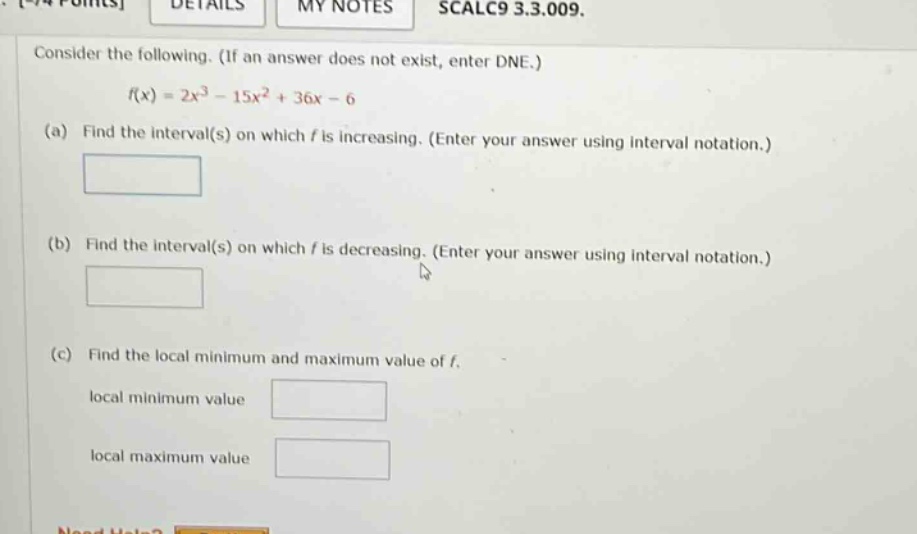
consider the following. (if an answer does not exist, enter dne.) f(x)=2x³ - 15x² + 36x - 6 (a) find the interval(s) on which f is increasing. (enter your answer using interval notation.) (b) find the interval(s) on which f is decreasing. (enter your answer using interval notation.) (c) find the local minimum and maximum value of f. local minimum value local maximum value
Answer
Explanation:
Step1: Find the derivative of (f(x))
Differentiate (f(x)=2x^{3}-15x^{2}+36x - 6) using the power - rule ((x^n)^\prime=nx^{n - 1}). (f^\prime(x)=6x^{2}-30x + 36)
Step2: Set (f^\prime(x)=0) to find critical points
Factor out 6 from (f^\prime(x)): (f^\prime(x)=6(x^{2}-5x + 6)). Set (x^{2}-5x + 6 = 0), factor the quadratic equation: ((x - 2)(x - 3)=0). The critical points are (x = 2) and (x=3).
Step3: Test the intervals determined by the critical points
Choose test points in the intervals ((-\infty,2)), ((2,3)) and ((3,\infty)). For the interval ((-\infty,2)), let (x = 1). Then (f^\prime(1)=6(1 - 5+6)=12>0). For the interval ((2,3)), let (x = 2.5). Then (f^\prime(2.5)=6(6.25-12.5 + 6)=6\times(-0.25)<0). For the interval ((3,\infty)), let (x = 4). Then (f^\prime(4)=6(16 - 20+6)=12>0).
Step4: Determine increasing and decreasing intervals
Since (f^\prime(x)>0) on ((-\infty,2)\cup(3,\infty)), (f(x)) is increasing on ((-\infty,2)\cup(3,\infty)). Since (f^\prime(x)<0) on ((2,3)), (f(x)) is decreasing on ((2,3)).
Step5: Find local minimum and maximum values
Evaluate (f(x)) at the critical points. (f(2)=2\times2^{3}-15\times2^{2}+36\times2 - 6=16-60 + 72-6=22). (f(3)=2\times3^{3}-15\times3^{2}+36\times3 - 6=54-135 + 108-6=21). Since (f(x)) changes from increasing to decreasing at (x = 2), (f(2)=22) is a local maximum. Since (f(x)) changes from decreasing to increasing at (x = 3), (f(3)=21) is a local minimum.
Answer:
(a) ((-\infty,2)\cup(3,\infty)) (b) ((2,3)) (c) local minimum value: (21) local maximum value: (22)