consider the following. (if an answer does not exist, enter dne.) f(x)=2x³ - 6x² + 3 (a) find the…
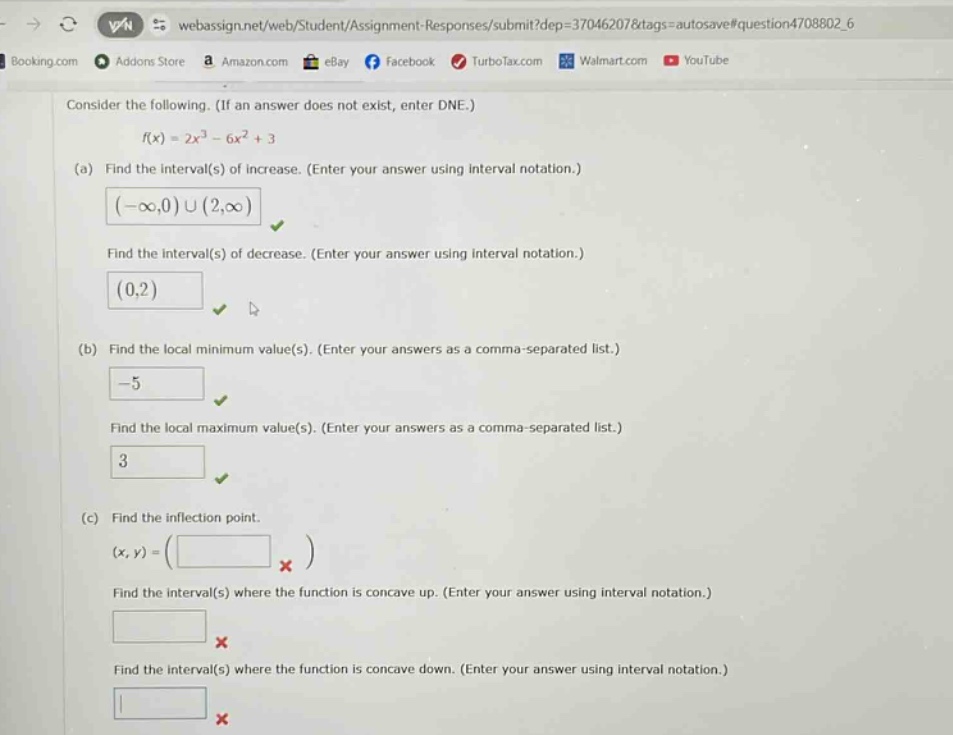
consider the following. (if an answer does not exist, enter dne.) f(x)=2x³ - 6x² + 3 (a) find the interval(s) of increase. (enter your answer using interval notation.) (-∞,0) ∪ (2,∞) find the interval(s) of decrease. (enter your answer using interval notation.) (0,2) (b) find the local minimum value(s). (enter your answers as a comma - separated list.) -5 find the local maximum value(s). (enter your answers as a comma - separated list.) 3 (c) find the inflection point. (x,y)=( ) find the interval(s) where the function is concave up. (enter your answer using interval notation.) find the interval(s) where the function is concave down. (enter your answer using interval notation.)
Answer
Explanation:
Step1: Find the first - derivative
Given $f(x)=2x^{3}-6x^{2}+3$, then $f^\prime(x)=6x^{2}-12x = 6x(x - 2)$.
Step2: Find the second - derivative
Differentiate $f^\prime(x)$ with respect to $x$. $f^{\prime\prime}(x)=12x-12=12(x - 1)$.
Step3: Find the inflection point
Set $f^{\prime\prime}(x)=0$. $12(x - 1)=0$, so $x = 1$. Substitute $x = 1$ into $f(x)$: $f(1)=2\times1^{3}-6\times1^{2}+3=2 - 6 + 3=-1$. So the inflection point is $(1,-1)$.
Step4: Find the concavity intervals
Set $f^{\prime\prime}(x)>0$ for concave - up intervals. $12(x - 1)>0$, which gives $x>1$. So the function is concave up on the interval $(1,\infty)$. Set $f^{\prime\prime}(x)<0$ for concave - down intervals. $12(x - 1)<0$, which gives $x<1$. So the function is concave down on the interval $(-\infty,1)$.
Answer:
$(x,y)=(1,-1)$ $(1,\infty)$ $(-\infty,1)$