consider the following. (if an answer does not exist, enter dne.) f(x)=x + 32/x^2 (a) find the interval(s)…
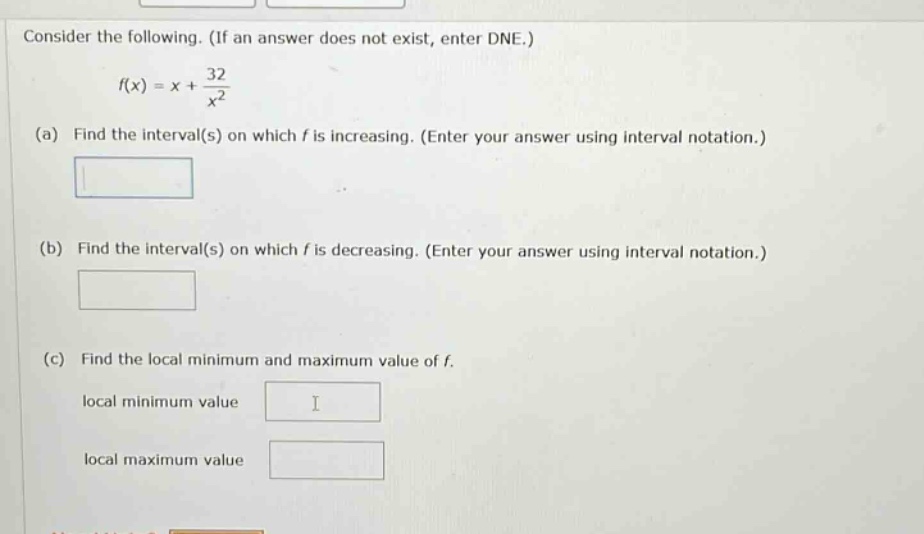
consider the following. (if an answer does not exist, enter dne.) f(x)=x + 32/x^2 (a) find the interval(s) on which f is increasing. (enter your answer using interval notation.) (b) find the interval(s) on which f is decreasing. (enter your answer using interval notation.) (c) find the local minimum and maximum value of f. local minimum value local maximum value
Answer
Explanation:
Step1: Find the derivative of $f(x)$
First, rewrite $f(x)=x + 32x^{-2}$. Then, using the power - rule $(x^n)'=nx^{n - 1}$, we have $f'(x)=1-64x^{-3}=1-\frac{64}{x^{3}}=\frac{x^{3}-64}{x^{3}}=\frac{(x - 4)(x^{2}+4x + 16)}{x^{3}}$. The discriminant of the quadratic factor $x^{2}+4x + 16$ is $\Delta=4^{2}-4\times16=-48<0$, so its roots are complex. The real root of $f'(x) = 0$ is $x = 4$, and $f'(x)$ is undefined at $x=0$.
Step2: Determine the sign of $f'(x)$ on intervals
We consider the intervals $(-\infty,0)$, $(0,4)$ and $(4,\infty)$. For $x\in(-\infty,0)$, let's take a test - point, say $x=-1$. Then $f'(-1)=\frac{(-1 - 4)((-1)^{2}+4\times(-1)+16)}{(-1)^{3}}=\frac{-5\times13}{-1}=65>0$. For $x\in(0,4)$, let's take $x = 1$. Then $f'(1)=\frac{(1 - 4)(1^{2}+4\times1 + 16)}{1^{3}}=\frac{-3\times21}{1}=-63<0$. For $x\in(4,\infty)$, let's take $x = 5$. Then $f'(5)=\frac{(5 - 4)(5^{2}+4\times5 + 16)}{5^{3}}=\frac{1\times51}{125}>0$.
Step3: Answer part (a)
Since $f'(x)>0$ on $(-\infty,0)\cup(4,\infty)$, the function $f(x)$ is increasing on the intervals $(-\infty,0)\cup(4,\infty)$.
Step4: Answer part (b)
Since $f'(x)<0$ on $(0,4)$, the function $f(x)$ is decreasing on the interval $(0,4)$.
Step5: Answer part (c)
Since $f(x)$ changes from increasing to decreasing at $x = 4$, $f(4)=4+\frac{32}{16}=4 + 2=6$ is a local minimum. And since $f(x)$ has no point where it changes from decreasing to increasing, there is no local maximum.
Answer:
(a) $(-\infty,0)\cup(4,\infty)$ (b) $(0,4)$ (c) local minimum value: $6$ local maximum value: DNE