consider the following. (if an answer does not exist, enter dne.) f(x)=x³ - 3x² - 6x + 3 find the…
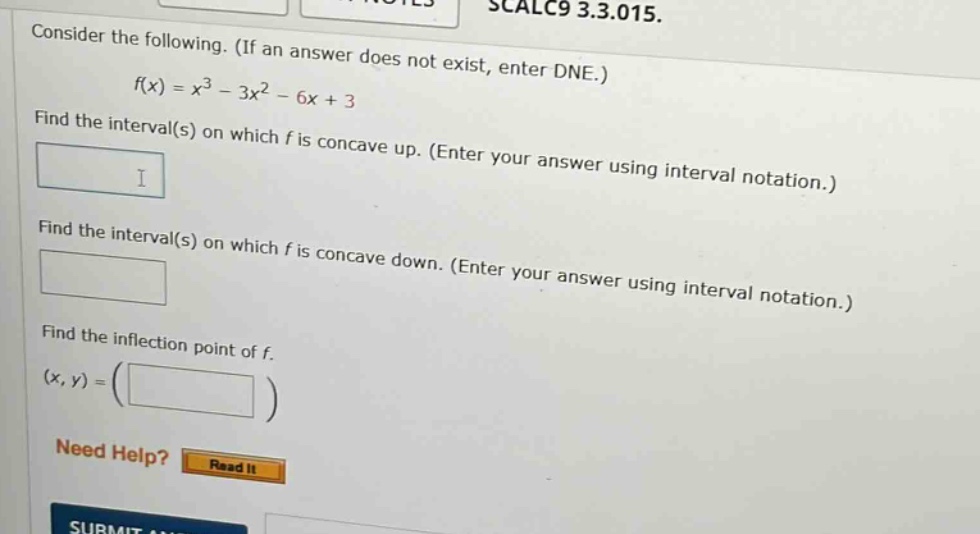
consider the following. (if an answer does not exist, enter dne.) f(x)=x³ - 3x² - 6x + 3 find the interval(s) on which f is concave up. (enter your answer using interval notation.) find the interval(s) on which f is concave down. (enter your answer using interval notation.) find the inflection point of f. (x,y)=( ) need help? read it
Answer
Explanation:
Step1: Find the first - derivative
Using the power rule $\frac{d}{dx}(x^n)=nx^{n - 1}$, for $f(x)=x^{3}-3x^{2}-6x + 3$, we have $f^\prime(x)=3x^{2}-6x-6$.
Step2: Find the second - derivative
Differentiate $f^\prime(x)$ again. $f^{\prime\prime}(x)=\frac{d}{dx}(3x^{2}-6x - 6)=6x-6$.
Step3: Find the inflection point
Set $f^{\prime\prime}(x) = 0$. Then $6x-6=0$. Solving for $x$ gives $x = 1$. Substitute $x = 1$ into $f(x)$: $f(1)=1^{3}-3\times1^{2}-6\times1 + 3=1-3-6 + 3=-5$. So the inflection point is $(1,-5)$.
Step4: Determine concavity intervals
Test intervals based on the inflection - point $x = 1$. For $x\lt1$, let's take $x = 0$. Then $f^{\prime\prime}(0)=6\times0-6=-6\lt0$, so $f(x)$ is concave down on the interval $(-\infty,1)$. For $x\gt1$, let's take $x = 2$. Then $f^{\prime\prime}(2)=6\times2-6 = 6\gt0$, so $f(x)$ is concave up on the interval $(1,\infty)$.
Answer:
- Concave up: $(1,\infty)$
- Concave down: $(-\infty,1)$
- Inflection point: $(1,-5)$