consider the following. (if an answer does not exist, enter dne.) f(x) = sin²(x) - cos(2x), 0 ≤ x ≤ π find…
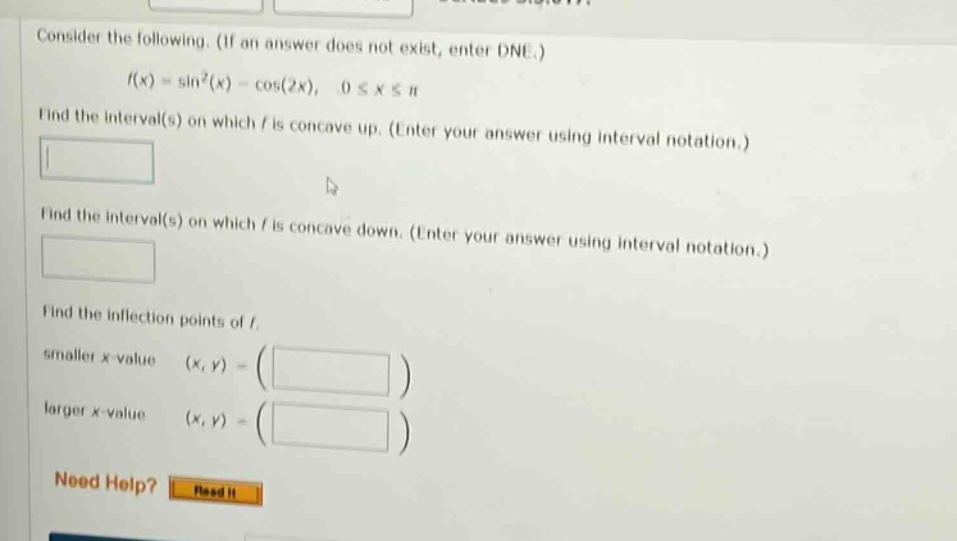
consider the following. (if an answer does not exist, enter dne.) f(x) = sin²(x) - cos(2x), 0 ≤ x ≤ π find the interval(s) on which f is concave up. (enter your answer using interval notation.) find the interval(s) on which f is concave down. (enter your answer using interval notation.) find the inflection points of f. smaller x - value (x,y) = ( ) larger x - value (x,y) = ( ) need help? read it
Answer
Explanation:
Step1: Rewrite the function
Use the double - angle formula $\cos(2x)=1 - 2\sin^{2}(x)$. Then $f(x)=\sin^{2}(x)-(1 - 2\sin^{2}(x))=3\sin^{2}(x)-1$.
Step2: Find the first - derivative
Using the chain - rule, if $y = 3u^{2}-1$ and $u=\sin(x)$, then $y^\prime=6u\cdot u^\prime$. So $f^\prime(x)=6\sin(x)\cos(x)=3\sin(2x)$.
Step3: Find the second - derivative
Using the chain - rule again, if $y = 3\sin(2x)$, then $y^{\prime\prime}=6\cos(2x)$.
Step4: Find the inflection points
Set $f^{\prime\prime}(x)=0$, so $6\cos(2x)=0$. Then $\cos(2x)=0$. For $0\leq x\leq\pi$, $2x=\frac{\pi}{2},\frac{3\pi}{2}$, so $x = \frac{\pi}{4},\frac{3\pi}{4}$. When $x=\frac{\pi}{4}$, $y = 3\sin^{2}(\frac{\pi}{4})-1=3\times\frac{1}{2}-1=\frac{1}{2}$. When $x=\frac{3\pi}{4}$, $y = 3\sin^{2}(\frac{3\pi}{4})-1=3\times\frac{1}{2}-1=\frac{1}{2}$. The inflection points are $(\frac{\pi}{4},\frac{1}{2})$ and $(\frac{3\pi}{4},\frac{1}{2})$.
Step5: Determine concavity
Test intervals: For the interval $[0,\frac{\pi}{4})$, let $x = 0$. Then $f^{\prime\prime}(0)=6\cos(0)=6>0$, so $f(x)$ is concave up on $[0,\frac{\pi}{4})$. For the interval $(\frac{\pi}{4},\frac{3\pi}{4})$, let $x=\frac{\pi}{2}$. Then $f^{\prime\prime}(\frac{\pi}{2})=6\cos(\pi)= - 6<0$, so $f(x)$ is concave down on $(\frac{\pi}{4},\frac{3\pi}{4})$. For the interval $(\frac{3\pi}{4},\pi]$, let $x=\pi$. Then $f^{\prime\prime}(\pi)=6\cos(2\pi)=6>0$, so $f(x)$ is concave up on $(\frac{3\pi}{4},\pi]$.
Answer:
Concave up: $[0,\frac{\pi}{4})\cup(\frac{3\pi}{4},\pi]$ Concave down: $(\frac{\pi}{4},\frac{3\pi}{4})$ Smaller $x$ - value inflection point: $(\frac{\pi}{4},\frac{1}{2})$ Larger $x$ - value inflection point: $(\frac{3\pi}{4},\frac{1}{2})$