consider the following. f(x) = √(5 - x) compare the values of δy and dy if x changes from 1 to 1.06. (round…
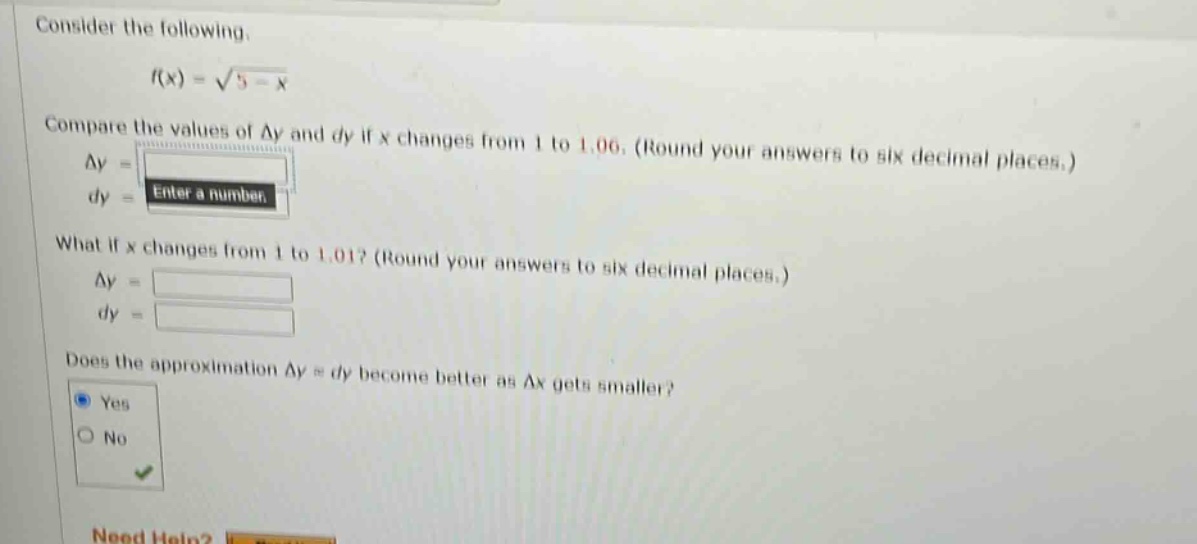
consider the following. f(x) = √(5 - x) compare the values of δy and dy if x changes from 1 to 1.06. (round your answers to six decimal places.) δy = enter a number dy = what if x changes from 1 to 1.01? (round your answers to six decimal places.) δy = dy = does the approximation δy ≈ dy become better as δx gets smaller? yes no
Answer
Explanation:
Step1: Recall the definitions
$\Delta y = f(x + \Delta x)-f(x)$ and $dy=f^{\prime}(x)dx$. First, find the derivative of $y = f(x)=\sqrt{5 - x}=(5 - x)^{\frac{1}{2}}$. Using the power - rule and chain - rule, $y^{\prime}=f^{\prime}(x)=\frac{-1}{2\sqrt{5 - x}}$.
Step2: When $x = 1$ and $\Delta x=0.06$
Calculate $\Delta y$
$f(1)=\sqrt{5 - 1}=2$, $f(1 + 0.06)=f(1.06)=\sqrt{5 - 1.06}=\sqrt{3.94}\approx1.984943$. Then $\Delta y=f(1.06)-f(1)\approx1.984943 - 2=-0.015057$.
Calculate $dy$
$f^{\prime}(1)=\frac{-1}{2\sqrt{5 - 1}}=-\frac{1}{4}=-0.25$, $dx=\Delta x = 0.06$, so $dy=f^{\prime}(1)dx=-0.25\times0.06=-0.015000$.
Step3: When $x = 1$ and $\Delta x = 0.01$
Calculate $\Delta y$
$f(1)=2$, $f(1 + 0.01)=f(1.01)=\sqrt{5 - 1.01}=\sqrt{3.99}\approx1.997498$. Then $\Delta y=f(1.01)-f(1)\approx1.997498 - 2=-0.002502$.
Calculate $dy$
$f^{\prime}(1)=-\frac{1}{4}=-0.25$, $dx=\Delta x = 0.01$, so $dy=f^{\prime}(1)dx=-0.25\times0.01=-0.002500$.
Answer:
When $x$ changes from $1$ to $1.06$: $\Delta y=-0.015057$ $dy=-0.015000$ When $x$ changes from $1$ to $1.01$: $\Delta y=-0.002502$ $dy=-0.002500$ Yes