consider the following equation: $f(x)=\frac{x^{2}+4}{4x^{2}-4x - 8}$. name the vertical asymptote(s). x =…
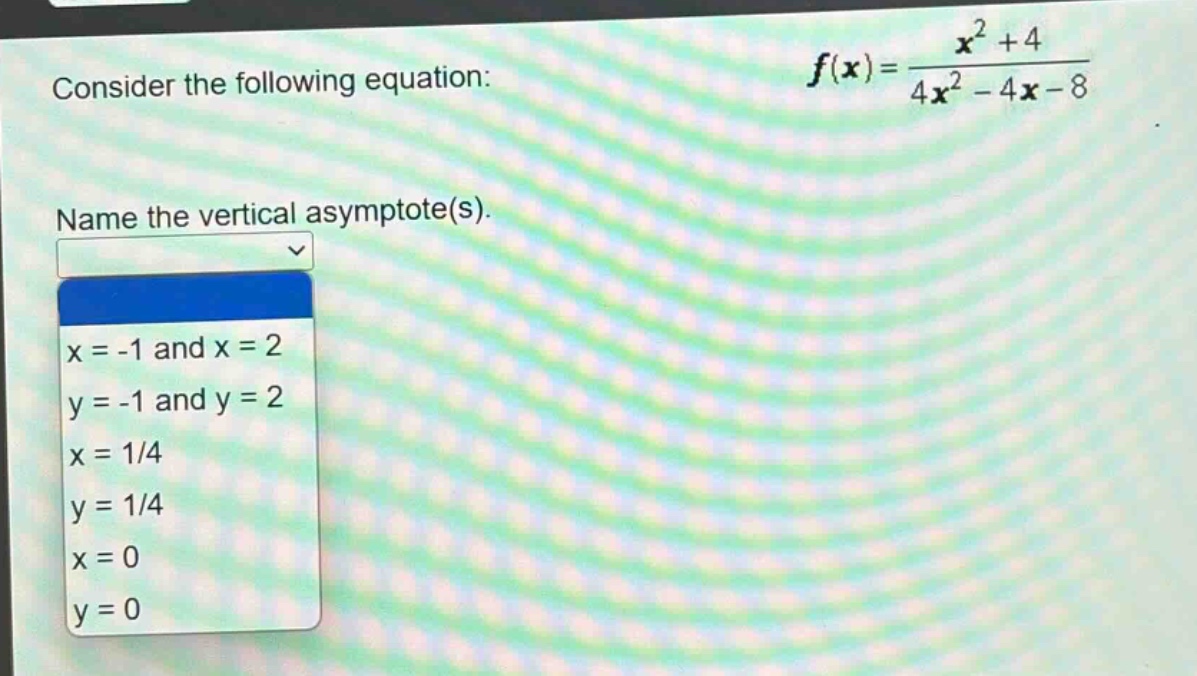
consider the following equation: $f(x)=\frac{x^{2}+4}{4x^{2}-4x - 8}$. name the vertical asymptote(s). x = -1 and x = 2 y = -1 and y = 2 x = 1/4 y = 1/4 x = 0 y = 0
Answer
Explanation:
Step1: Find the denominator's zeros
Set the denominator $4x^{2}-4x - 8=0$. First, factor out a 4: $4(x^{2}-x - 2)=0$. Then factor the quadratic: $4(x - 2)(x+1)=0$.
Step2: Solve for x
Using the zero - product property, if $4(x - 2)(x + 1)=0$, then $x-2=0$ or $x + 1=0$. Solving these gives $x=2$ or $x=-1$. Vertical asymptotes occur at the values of $x$ that make the denominator zero (while the numerator is non - zero at those points). The numerator $x^{2}+4$ is non - zero for $x = 2$ and $x=-1$.
Answer:
$x=-1$ and $x = 2$