consider the following function. g(x) = x^3 - 15x find the first and second derivatives of the function…
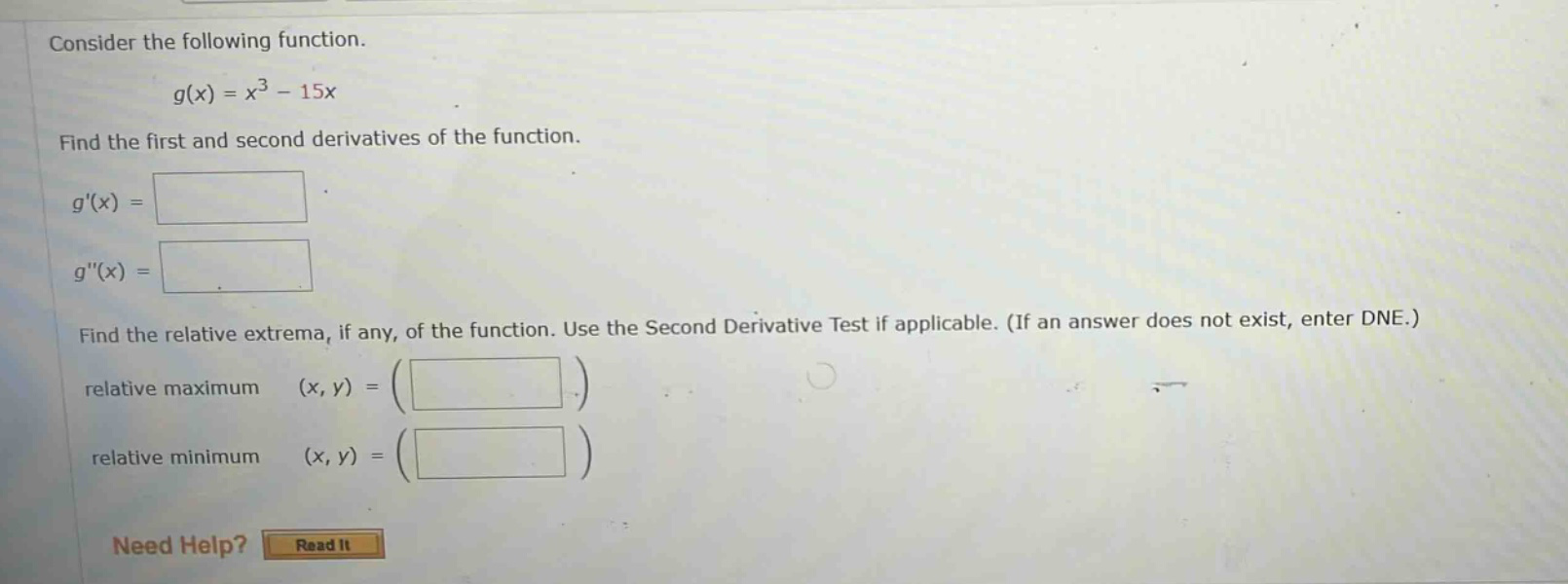
consider the following function. g(x) = x^3 - 15x find the first and second derivatives of the function. g(x) = g(x) = find the relative extrema, if any, of the function. use the second derivative test if applicable. (if an answer does not exist, enter dne.) relative maximum (x, y) = relative minimum (x, y) = need help? read it
Answer
Explanation:
Step1: Find the first - derivative
Using the power rule $\frac{d}{dx}(x^n)=nx^{n - 1}$, for $g(x)=x^{3}-15x$, we have $g'(x)=\frac{d}{dx}(x^{3})-\frac{d}{dx}(15x)=3x^{2}-15$.
Step2: Find the second - derivative
Differentiate $g'(x)=3x^{2}-15$ with respect to $x$. Using the power rule again, $g''(x)=\frac{d}{dx}(3x^{2})-\frac{d}{dx}(15)=6x$.
Step3: Find the critical points
Set $g'(x) = 0$. So, $3x^{2}-15 = 0$. Add 15 to both sides: $3x^{2}=15$. Divide both sides by 3: $x^{2}=5$. Then $x=\pm\sqrt{5}$.
Step4: Use the second - derivative test
When $x =-\sqrt{5}$, $g''(-\sqrt{5})=6(-\sqrt{5})=-6\sqrt{5}<0$. So, the function has a relative maximum at $x =-\sqrt{5}$. Substitute $x =-\sqrt{5}$ into $g(x)$: $g(-\sqrt{5})=(-\sqrt{5})^{3}-15(-\sqrt{5})=-5\sqrt{5}+15\sqrt{5}=10\sqrt{5}$. When $x=\sqrt{5}$, $g''(\sqrt{5})=6\sqrt{5}>0$. So, the function has a relative minimum at $x=\sqrt{5}$. Substitute $x = \sqrt{5}$ into $g(x)$: $g(\sqrt{5})=(\sqrt{5})^{3}-15\sqrt{5}=5\sqrt{5}-15\sqrt{5}=-10\sqrt{5}$.
Answer:
$g'(x)=3x^{2}-15$ $g''(x)=6x$ relative maximum $(x,y)=(-\sqrt{5},10\sqrt{5})$ relative minimum $(x,y)=(\sqrt{5},-10\sqrt{5})$