consider the following function: f(x)=(25 - x^2)/(x^2 - 4x - 5) which of the following are correct? check…
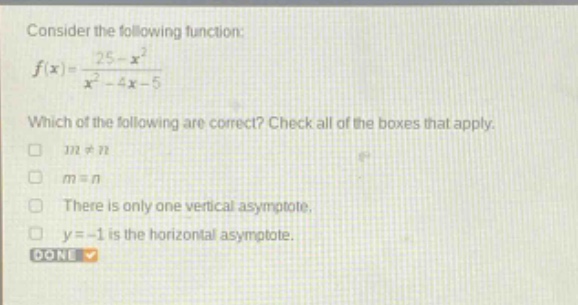
consider the following function: f(x)=(25 - x^2)/(x^2 - 4x - 5) which of the following are correct? check all of the boxes that apply. m≠n m = n there is only one vertical asymptote. y = - 1 is the horizontal asymptote. done
Answer
Explanation:
Step1: Factor the function
First, factor the numerator and denominator. The numerator (25 - x^{2}=(5 + x)(5 - x)) and the denominator (x^{2}-4x - 5=(x - 5)(x+1)). So (f(x)=\frac{(5 + x)(5 - x)}{(x - 5)(x + 1)}), and (x\neq5,x\neq - 1).
Step2: Find vertical asymptotes
Vertical asymptotes occur where the denominator is zero and the numerator is non - zero. Set the denominator ((x - 5)(x + 1)=0), we get (x = 5) and (x=-1) are the vertical asymptotes. So the statement "There is only one vertical asymptote" is false.
Step3: Find horizontal asymptote
For a rational function (y=\frac{f(x)}{g(x)}) where (f(x)) and (g(x)) are polynomials of degree (m) and (n) respectively. Here, the degree of the numerator and denominator are both 2. The horizontal asymptote (y) is given by the ratio of the leading coefficients. The leading coefficient of the numerator of (f(x)) is (-1) and the leading coefficient of the denominator is (1). So (y=-1) is the horizontal asymptote. Since there is no information about (m) and (n) in the context of the function itself, we can't determine the relationship between (m) and (n) from the function (f(x)=\frac{25 - x^{2}}{x^{2}-4x - 5}).
Answer:
y = - 1 is the horizontal asymptote.