consider the following function. g(x) = 2x² + 864/x + 15 find the derivative of the function. g(x) = find…
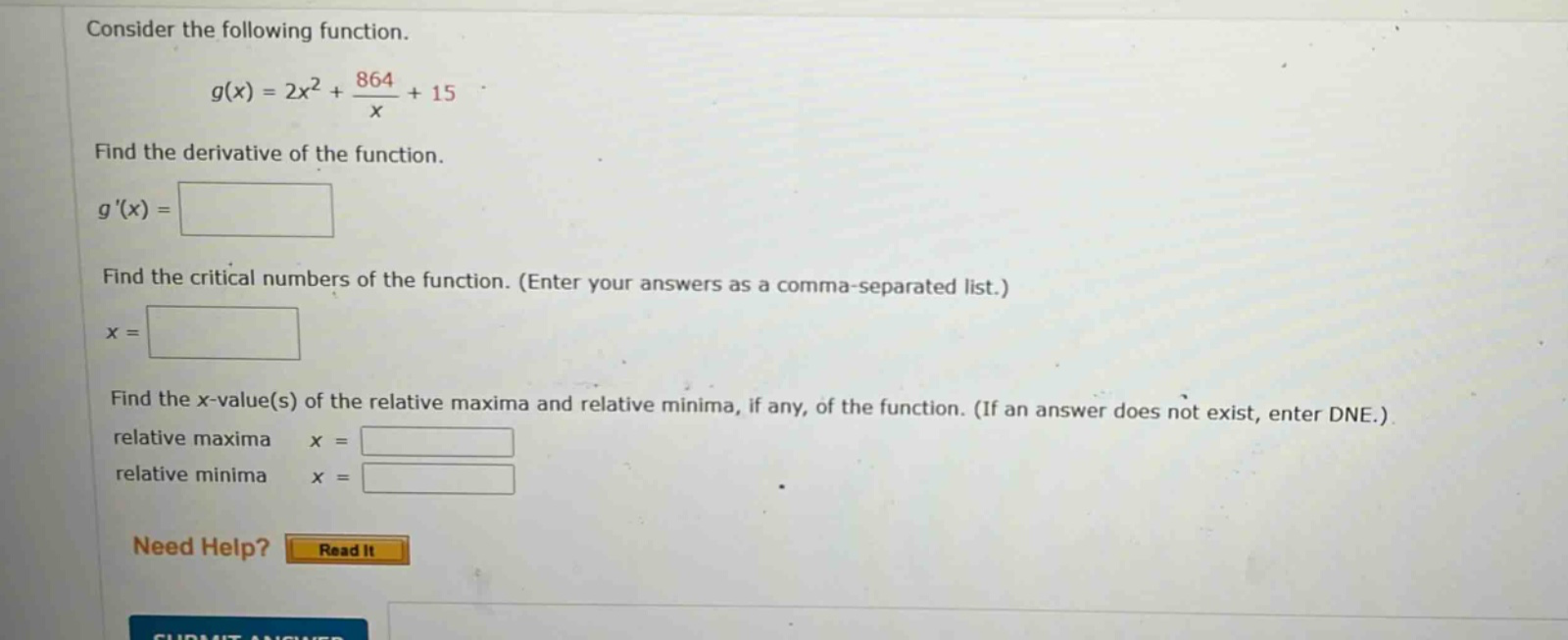
consider the following function. g(x) = 2x² + 864/x + 15 find the derivative of the function. g(x) = find the critical numbers of the function. (enter your answers as a comma - separated list.) x = find the x - value(s) of the relative maxima and relative minima, if any, of the function. (if an answer does not exist, enter dne.) relative maxima x = relative minima x =
Answer
Explanation:
Step1: Find the derivative
Use the power - rule $\frac{d}{dx}(x^n)=nx^{n - 1}$. $g(x)=2x^{2}+\frac{864}{x}+15=2x^{2}+864x^{-1}+15$. $g'(x)=\frac{d}{dx}(2x^{2})+\frac{d}{dx}(864x^{-1})+\frac{d}{dx}(15)=4x-864x^{-2}=4x-\frac{864}{x^{2}}$.
Step2: Find the critical numbers
Set $g'(x) = 0$. $4x-\frac{864}{x^{2}} = 0$. Multiply through by $x^{2}$ (assuming $x\neq0$) to get $4x^{3}-864 = 0$. $4x^{3}=864$, then $x^{3}=216$, so $x = 6$.
Step3: Find the second - derivative
$g'(x)=4x-\frac{864}{x^{2}}$, then $g''(x)=\frac{d}{dx}(4x)-\frac{d}{dx}(\frac{864}{x^{2}})=4 + 1728x^{-3}=4+\frac{1728}{x^{3}}$.
Step4: Classify the critical point
Evaluate $g''(6)$: $g''(6)=4+\frac{1728}{216}=4 + 8=12>0$. Since $g''(6)>0$, the function has a relative minimum at $x = 6$ and no relative maximum.
Answer:
$g'(x)=4x-\frac{864}{x^{2}}$ $x = 6$ relative maxima: DNE relative minima: $x = 6$