consider the following function.\n$f(x)=x^{3}+3x^{2}-24x + 7$\n(a) make a sign diagram for the first…
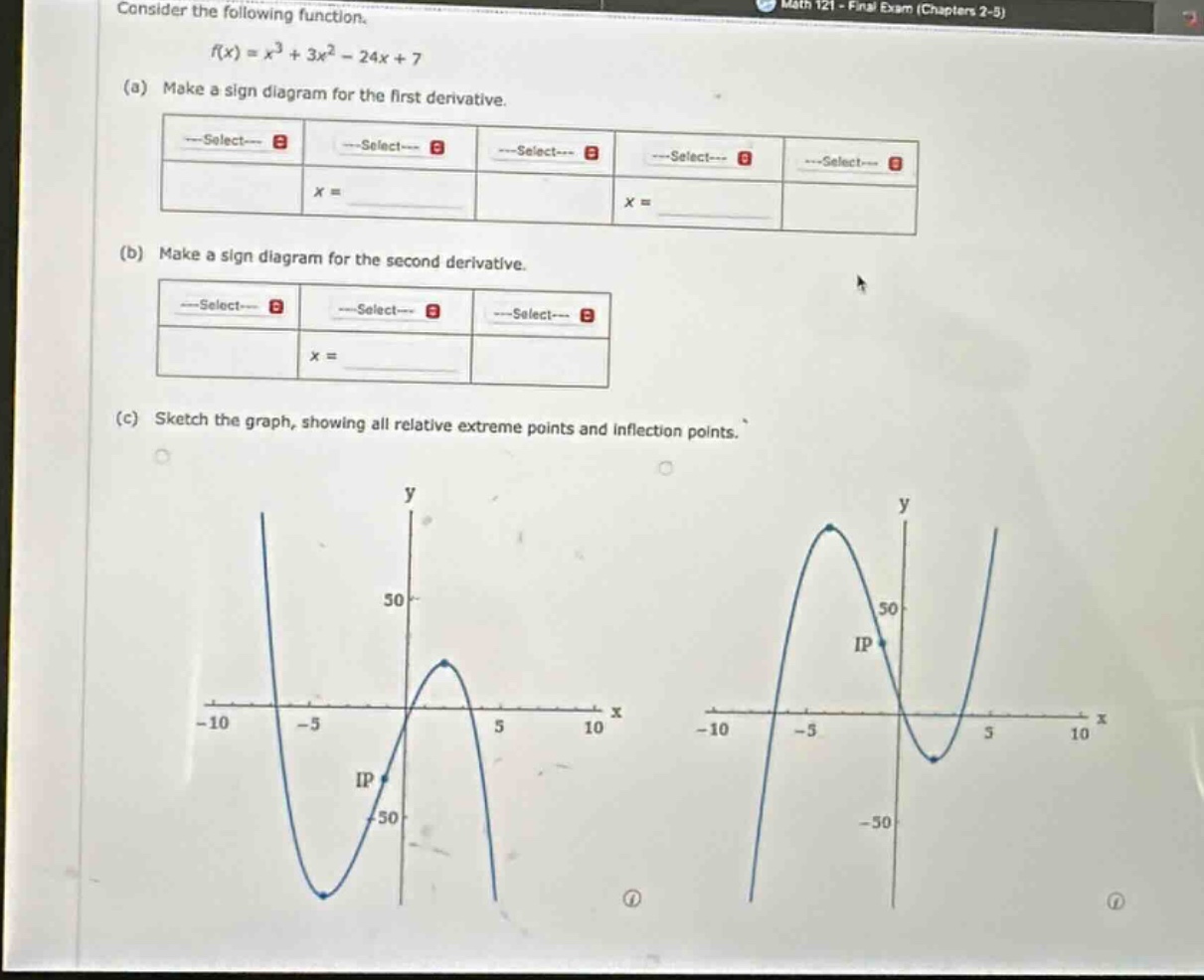
consider the following function.\n$f(x)=x^{3}+3x^{2}-24x + 7$\n(a) make a sign diagram for the first derivative.\n(b) make a sign diagram for the second derivative.\n(c) sketch the graph, showing all relative extreme points and inflection points.
Answer
Explanation:
Step1: Find the first - derivative
Using the power rule $(x^n)'=nx^{n - 1}$, if $f(x)=x^{3}+3x^{2}-24x + 7$, then $f'(x)=3x^{2}+6x-24=3(x^{2}+2x - 8)=3(x + 4)(x - 2)$.
Step2: Find the critical points
Set $f'(x)=0$, so $3(x + 4)(x - 2)=0$. The critical points are $x=-4$ and $x = 2$.
Step3: Make the sign - diagram for the first - derivative
Test the intervals $(-\infty,-4)$, $(-4,2)$ and $(2,\infty)$. For $x<-4$, let $x=-5$, then $f'(-5)=3(-5 + 4)(-5 - 2)=3\times(-1)\times(-7)=21>0$. For $-4<x<2$, let $x = 0$, then $f'(0)=3(0 + 4)(0 - 2)=3\times4\times(-2)=-24<0$. For $x>2$, let $x = 3$, then $f'(3)=3(3 + 4)(3 - 2)=3\times7\times1 = 21>0$. The sign - diagram for $f'(x)$: $+$ for $x\in(-\infty,-4)$, $-$ for $x\in(-4,2)$ and $+$ for $x\in(2,\infty)$.
Step4: Find the second - derivative
Differentiate $f'(x)=3x^{2}+6x - 24$ with respect to $x$. Using the power rule, $f''(x)=6x+6=6(x + 1)$.
Step5: Find the inflection point
Set $f''(x)=0$, so $6(x + 1)=0$, which gives $x=-1$.
Step6: Make the sign - diagram for the second - derivative
Test the intervals $(-\infty,-1)$ and $(-1,\infty)$. For $x<-1$, let $x=-2$, then $f''(-2)=6(-2 + 1)=-6<0$. For $x>-1$, let $x = 0$, then $f''(0)=6(0 + 1)=6>0$. The sign - diagram for $f''(x)$: $-$ for $x\in(-\infty,-1)$ and $+$ for $x\in(-1,\infty)$.
Step7: Find the relative extreme points
Since $f(x)$ changes from increasing ($f'(x)>0$) to decreasing ($f'(x)<0$) at $x=-4$, $f(-4)=(-4)^{3}+3(-4)^{2}-24(-4)+7=-64 + 48+96 + 7=87$ is a relative maximum. Since $f(x)$ changes from decreasing ($f'(x)<0$) to increasing ($f'(x)>0$) at $x = 2$, $f(2)=2^{3}+3\times2^{2}-24\times2+7=8 + 12-48 + 7=-21$ is a relative minimum. The inflection point is at $x=-1$, and $f(-1)=(-1)^{3}+3(-1)^{2}-24(-1)+7=-1 + 3+24 + 7=33$.
Answer:
(a) Sign - diagram for $f'(x)$: $+$ for $x\in(-\infty,-4)$, $x=-4$, $-$ for $x\in(-4,2)$, $x = 2$, $+$ for $x\in(2,\infty)$. (b) Sign - diagram for $f''(x)$: $-$ for $x\in(-\infty,-1)$, $x=-1$, $+$ for $x\in(-1,\infty)$. (c) Relative maximum at $(-4,87)$, relative minimum at $(2,-21)$, inflection point at $(-1,33)$. Sketch the graph with a curve increasing from $(-\infty,-4)$, having a peak at $(-4,87)$, decreasing to $(2,-21)$, then increasing again, and changing concavity at $(-1,33)$ from concave - down to concave - up.