consider the following function. f(x) = e^(-4x) complete the table. n f^(n)(0) 0 1 2 3 4
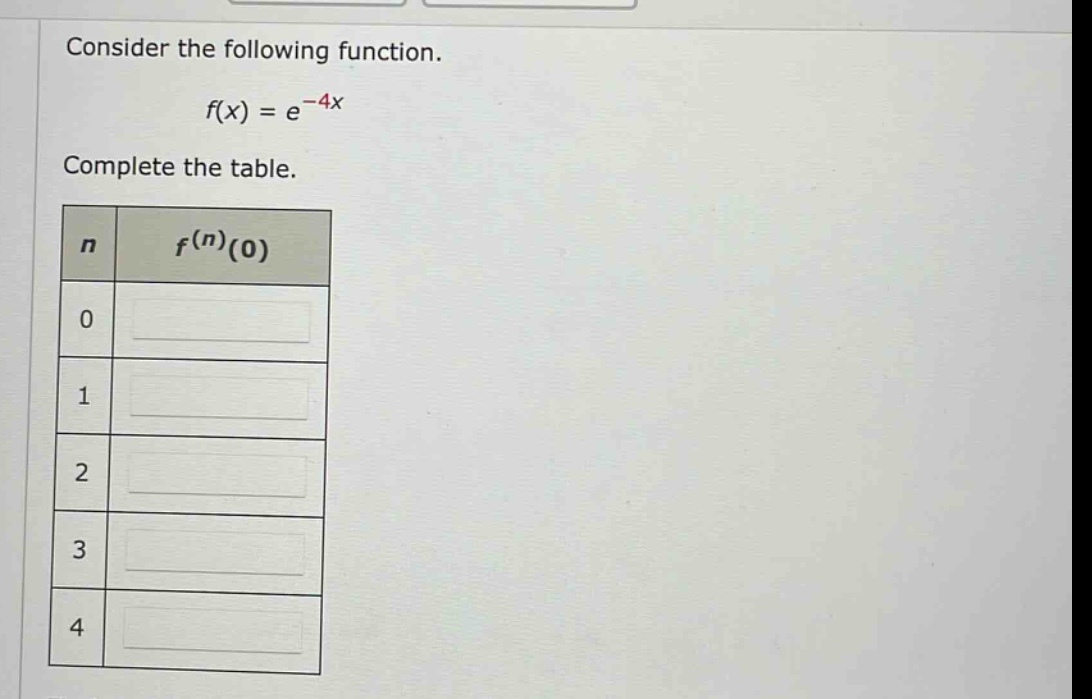
consider the following function. f(x) = e^(-4x) complete the table. n f^(n)(0) 0 1 2 3 4
Answer
Explanation:
Step1: Recall the definition of $n$-th derivative and $n = 0$ case
When $n = 0$, $f^{(0)}(x)=f(x)$. Substitute $x = 0$ into $f(x)=e^{-4x}$. $f^{(0)}(0)=e^{-4\times0}=e^{0}=1$
Step2: Find the first - derivative
Use the chain - rule. If $y = e^{u}$ and $u=-4x$, then $\frac{dy}{dx}=\frac{dy}{du}\cdot\frac{du}{dx}$. The derivative of $y = e^{u}$ with respect to $u$ is $e^{u}$, and the derivative of $u=-4x$ with respect to $x$ is $-4$. So $f^{\prime}(x)=\frac{d}{dx}(e^{-4x})=-4e^{-4x}$. Substitute $x = 0$: $f^{\prime}(0)=-4e^{-4\times0}=-4$
Step3: Find the second - derivative
Differentiate $f^{\prime}(x)=-4e^{-4x}$ again. Using the chain - rule, $f^{\prime\prime}(x)=\frac{d}{dx}(-4e^{-4x})=(-4)\times(-4)e^{-4x}=(-4)^{2}e^{-4x}$. Substitute $x = 0$: $f^{\prime\prime}(0)=(-4)^{2}e^{-4\times0}=16$
Step4: Find the third - derivative
Differentiate $f^{\prime\prime}(x)=(-4)^{2}e^{-4x}$ again. Using the chain - rule, $f^{(3)}(x)=\frac{d}{dx}((-4)^{2}e^{-4x})=(-4)^{3}e^{-4x}$. Substitute $x = 0$: $f^{(3)}(0)=(-4)^{3}e^{-4\times0}=-64$
Step5: Find the fourth - derivative
Differentiate $f^{(3)}(x)=(-4)^{3}e^{-4x}$ again. Using the chain - rule, $f^{(4)}(x)=\frac{d}{dx}((-4)^{3}e^{-4x})=(-4)^{4}e^{-4x}$. Substitute $x = 0$: $f^{(4)}(0)=(-4)^{4}e^{-4\times0}=256$
Answer:
| $n$ | $f^{(n)}(0)$ |
|---|---|
| 0 | 1 |
| 1 | - 4 |
| 2 | 16 |
| 3 | - 64 |
| 4 | 256 |