consider the following function.\n v(x)=\begin{cases}\frac{3}{4x^{5}}&\text{if }x < 1\\-\frac{7}{9}x&\text{if…
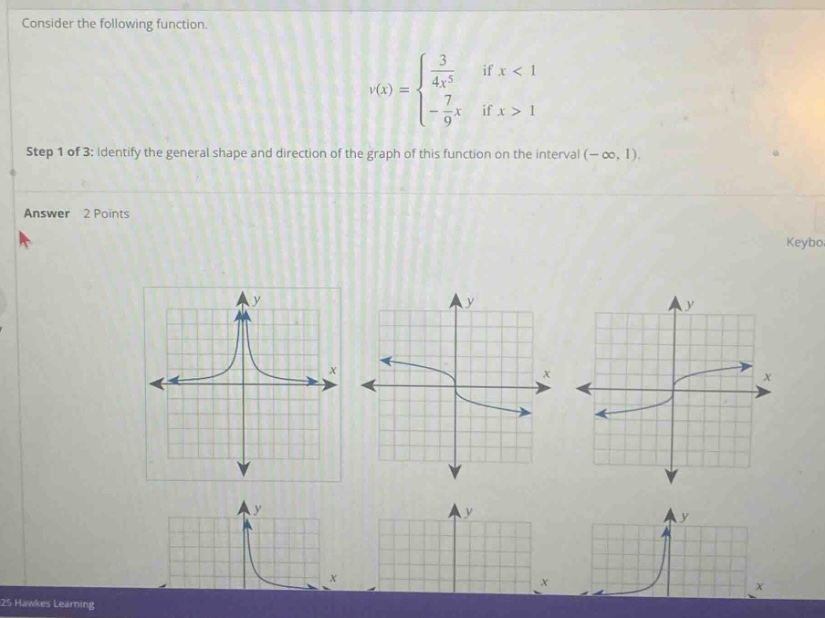
consider the following function.\n v(x)=\begin{cases}\frac{3}{4x^{5}}&\text{if }x < 1\\-\frac{7}{9}x&\text{if }x > 1end{cases}\nstep 1 of 3: identify the general shape and direction of the graph of this function on the interval ((-infty,1)).\nanswer 2 points
Answer
Explanation:
Step1: Analyze the function for $x<1$
The function for $x < 1$ is $y(x)=\frac{3}{4x^{5}}$. When $x<1$, as $x$ approaches $0$ from the left side ($x\to0^{-}$), $y\to-\infty$; as $x$ approaches $-\infty$, $y\to0^{-}$. Also, the derivative of $y = \frac{3}{4x^{5}}=\frac{3}{4}x^{- 5}$ using the power - rule $(x^n)'=nx^{n - 1}$ is $y'=-\frac{15}{4}x^{-6}=-\frac{15}{4x^{6}}<0$ for $x<1$. So the function is decreasing on $(-\infty,0)$ and $(0,1)$. The function has a vertical asymptote at $x = 0$.
Answer:
The graph is a decreasing curve with a vertical asymptote at $x = 0$ on the interval $(-\infty,1)$. It approaches $y = 0$ as $x\to-\infty$ and approaches $-\infty$ as $x\to0^{-}$.