consider the following function. f(x) = ln(1 + 4x) complete the table. n f^(n)(0) 0 1 2 3 4 find the…
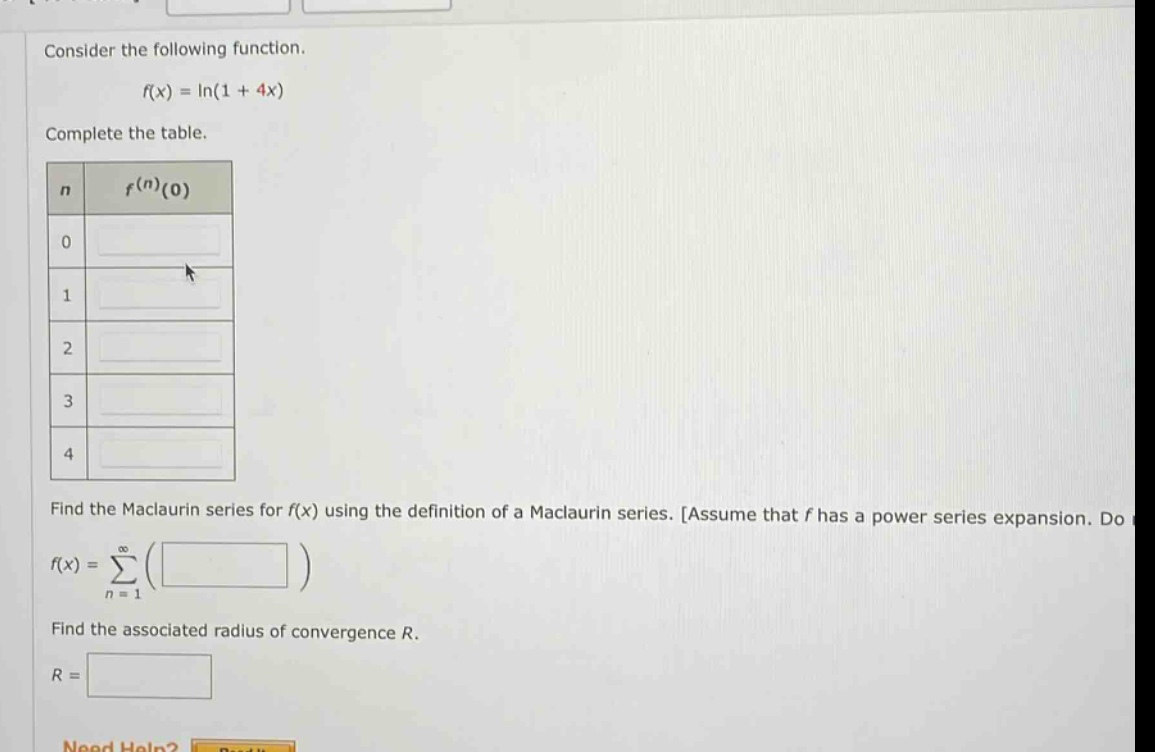
consider the following function. f(x) = ln(1 + 4x) complete the table. n f^(n)(0) 0 1 2 3 4 find the maclaurin series for f(x) using the definition of a maclaurin series. assume that f has a power series expansion. do f(x)=∑_(n = 1)^(∞)( ) find the associated radius of convergence r. r =
Answer
Explanation:
Step1: Find (f(0))
When (n = 0), (f(x)=\ln(1 + 4x)), so (f(0)=\ln(1+4\times0)=\ln(1)=0)
Step2: Find the first - derivative
Differentiate (y = f(x)=\ln(1 + 4x)) using the chain - rule. Let (u = 1+4x), then (y=\ln(u)). (\frac{dy}{du}=\frac{1}{u}) and (\frac{du}{dx}=4). So (f^{\prime}(x)=\frac{4}{1 + 4x}), and (f^{\prime}(0)=\frac{4}{1+4\times0}=4)
Step3: Find the second - derivative
Differentiate (f^{\prime}(x)=\frac{4}{1 + 4x}=4(1 + 4x)^{-1}) using the chain - rule. (f^{\prime\prime}(x)=4\times(-1)\times4\times(1 + 4x)^{-2}=-\frac{4^{2}}{(1 + 4x)^{2}}), and (f^{\prime\prime}(0)=-4^{2})
Step4: Find the third - derivative
Differentiate (f^{\prime\prime}(x)=-4^{2}(1 + 4x)^{-2}) using the chain - rule. (f^{(3)}(x)=-4^{2}\times(-2)\times4\times(1 + 4x)^{-3}=\frac{4^{3}\times2!}{(1 + 4x)^{3}}), and (f^{(3)}(0)=4^{3}\times2!)
Step5: Find the fourth - derivative
Differentiate (f^{(3)}(x)=4^{3}\times2!(1 + 4x)^{-3}) using the chain - rule. (f^{(4)}(x)=4^{3}\times2!\times(-3)\times4\times(1 + 4x)^{-4}=-\frac{4^{4}\times3!}{(1 + 4x)^{4}}), and (f^{(4)}(0)=-4^{4}\times3!)
Step6: Find the Maclaurin series
The Maclaurin series is (f(x)=\sum_{n = 1}^{\infty}\frac{f^{(n)}(0)}{n!}x^{n}). From the above results, (f^{(n)}(0)=(-1)^{n - 1}(n - 1)!4^{n}), so (f(x)=\sum_{n = 1}^{\infty}\frac{(-1)^{n - 1}(n - 1)!4^{n}}{n!}x^{n}=\sum_{n = 1}^{\infty}\frac{(-1)^{n - 1}4^{n}}{n}x^{n})
Step7: Find the radius of convergence
Use the ratio test. Let (a_{n}=\frac{(-1)^{n - 1}4^{n}}{n}x^{n}). Then (\lim_{n\rightarrow\infty}\left|\frac{a_{n + 1}}{a_{n}}\right|=\lim_{n\rightarrow\infty}\left|\frac{\frac{(-1)^{n}4^{n+1}}{n + 1}x^{n+1}}{\frac{(-1)^{n - 1}4^{n}}{n}x^{n}}\right|=\lim_{n\rightarrow\infty}\left|\frac{(-1)^{n}4^{n+1}n x^{n+1}}{(-1)^{n - 1}4^{n}(n + 1)x^{n}}\right|=\lim_{n\rightarrow\infty}\left|\frac{-4nx}{n + 1}\right|=\lim_{n\rightarrow\infty}\left|\frac{-4x}{1+\frac{1}{n}}\right| = 4|x|) Set (4|x|\lt1), then (|x|\lt\frac{1}{4}), so the radius of convergence (R=\frac{1}{4})
Answer:
| (n) | (f^{(n)}(0)) |
|---|---|
| (0) | (0) |
| (1) | (4) |
| (2) | (-4^{2}) |
| (3) | (4^{3}\times2!) |
| (4) | (-4^{4}\times3!) |
(f(x)=\sum_{n = 1}^{\infty}\frac{(-1)^{n - 1}4^{n}}{n}x^{n})
(R=\frac{1}{4})