consider the following function. r(x)=-3√(x - 3)-1 step 1 of 2: graph the original function by indicating…
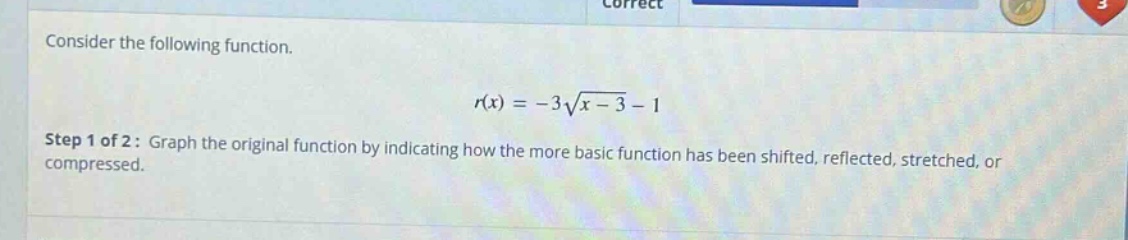
consider the following function. r(x)=-3√(x - 3)-1 step 1 of 2: graph the original function by indicating how the more basic function has been shifted, reflected, stretched, or compressed.
Answer
Explanation:
Step1: Identify the basic function
The basic function is $y = \sqrt{x}$.
Step2: Analyze horizontal shift
For the function $r(x)=-3\sqrt{x - 3}-1$, inside the square - root, we have $x-3$. According to the rule $y = f(x - h)$ shifts the graph of $y = f(x)$ to the right by $h$ units. Here $h = 3$, so the graph of $y=\sqrt{x}$ is shifted 3 units to the right.
Step3: Analyze vertical stretch and reflection
The coefficient of the square - root is $-3$. The negative sign reflects the graph of $y=\sqrt{x - 3}$ about the $x$-axis, and the absolute value of 3 stretches the graph of $y = \sqrt{x - 3}$ vertically by a factor of 3.
Step4: Analyze vertical shift
The constant term $-1$ shifts the graph of $y=-3\sqrt{x - 3}$ down 1 unit.
The graph of $y = \sqrt{x}$ is shifted 3 units to the right, reflected about the $x$-axis, vertically stretched by a factor of 3, and shifted 1 unit down to get the graph of $r(x)=-3\sqrt{x - 3}-1$.
Answer:
The graph of $y = \sqrt{x}$ is shifted 3 units to the right, reflected about the $x$-axis, vertically stretched by a factor of 3, and shifted 1 unit down.