consider the following function. f(x)=-2√x + 5 step 1 of 2: graph the original function by indicating how…
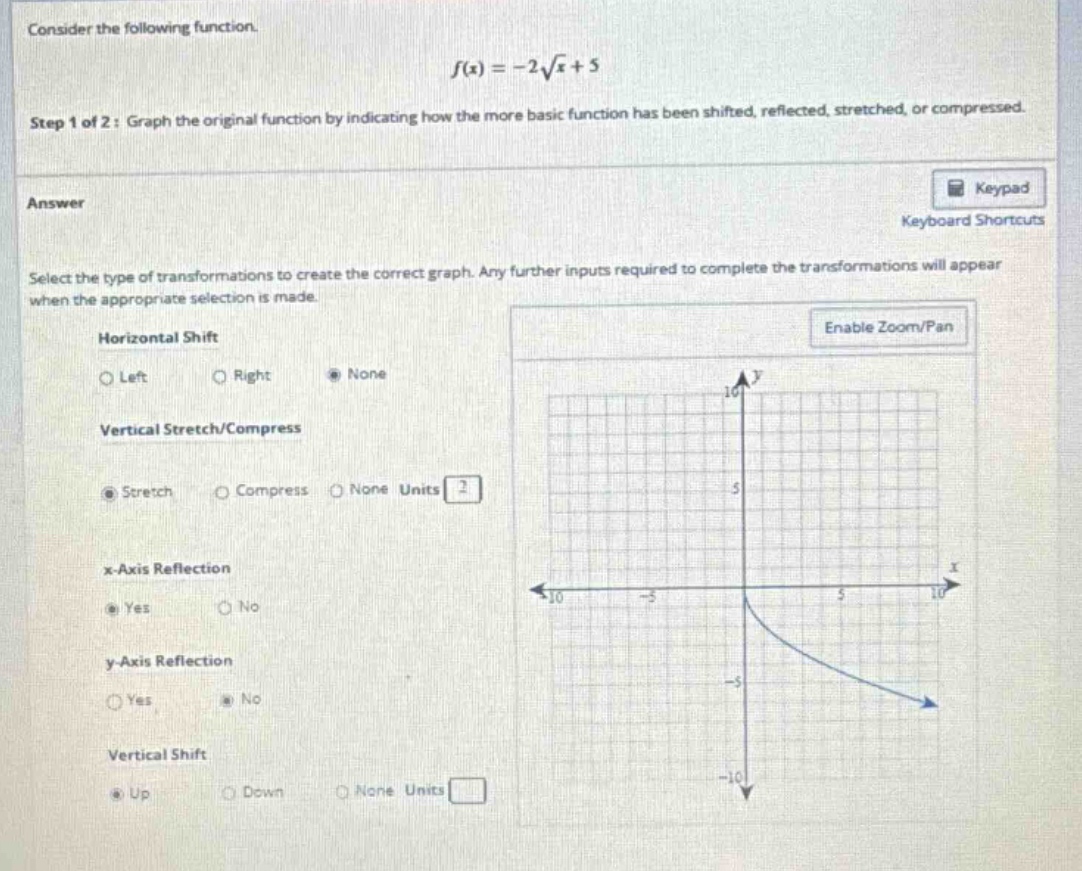
consider the following function. f(x)=-2√x + 5 step 1 of 2: graph the original function by indicating how the more basic function has been shifted, reflected, stretched, or compressed. answer select the type of transformations to create the correct graph. any further inputs required to complete the transformations will appear when the appropriate selection is made. horizontal shift left right none vertical stretch/compress stretch compress none units 2 x - axis reflection yes no y - axis reflection yes no vertical shift up down none units
Answer
Explanation:
Step1: Identify the basic function
The basic function is $y = \sqrt{x}$.
Step2: Analyze vertical stretch/compression
The coefficient of $\sqrt{x}$ is -2. The absolute - value of -2 is 2, so there is a vertical stretch by a factor of 2.
Step3: Analyze x - axis reflection
The negative sign in front of 2 indicates a reflection across the x - axis.
Step4: Analyze vertical shift
The + 5 at the end of the function $f(x)=-2\sqrt{x}+5$ indicates a vertical shift up by 5 units.
Step5: Analyze horizontal and y - axis reflection
There is no addition or subtraction inside the square - root function to cause a horizontal shift, and no negative sign on the x inside the square - root to cause a y - axis reflection.
Answer:
Horizontal Shift: None Vertical Stretch/Compress: Stretch, 2 units x - Axis Reflection: Yes y - Axis Reflection: No Vertical Shift: Up, 5 units