consider the following integrand (f_b(x,y)).\n(iint_r f_b(x,y) da=iint_r e^{-2x + 9y}cos(9x - 2y)…
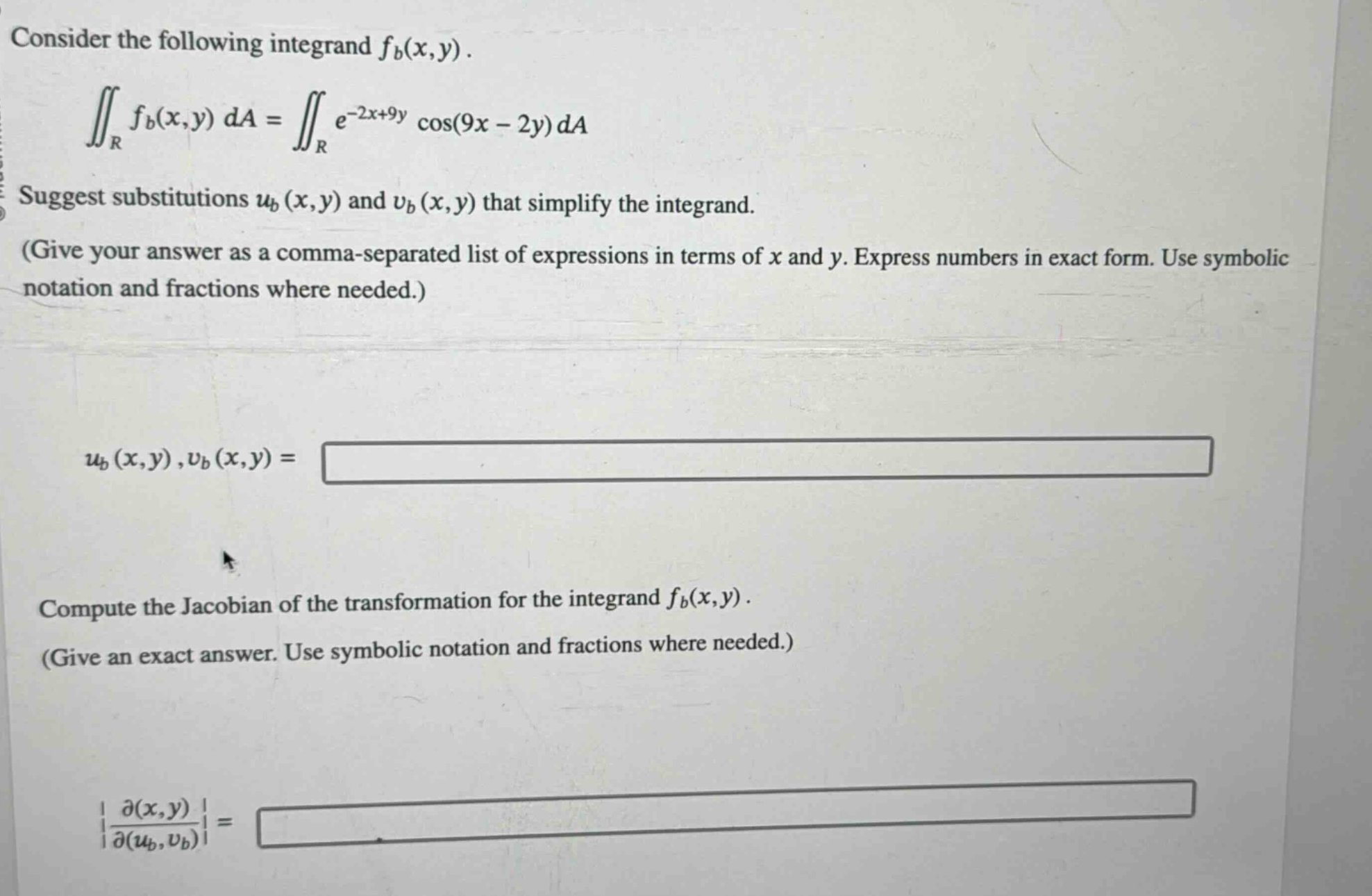
consider the following integrand (f_b(x,y)).\n(iint_r f_b(x,y) da=iint_r e^{-2x + 9y}cos(9x - 2y) da)\nsuggest substitutions (u_b(x,y)) and (v_b(x,y)) that simplify the integrand.\n(give your answer as a comma - separated list of expressions in terms of (x) and (y). express numbers in exact form. use symbolic notation and fractions where needed.)\n(u_b(x,y),v_b(x,y)=)\ncompute the jacobian of the transformation for the integrand (f_b(x,y)).\n(give an exact answer. use symbolic notation and fractions where needed.)\n(left|\frac{partial(x,y)}{partial(u_b,v_b)}\right|=)
Answer
Explanation:
Step1: Choose substitutions
Let (u_b=-2x + 9y) and (v_b=9x-2y). This simplifies the integrand as the exponential and cosine - functions will be in terms of (u_b) and (v_b) respectively.
Step2: Find the inverse transformation
We have the system of equations (\begin{cases}u=-2x + 9y\v = 9x-2y\end{cases}). Solve for (x) and (y) in terms of (u) and (v). First, multiply the first equation by 2 and the second by 9: (\begin{cases}2u=-4x + 18y\9v=81x-18y\end{cases}). Adding these two equations gives (2u + 9v=77x), so (x=\frac{2u + 9v}{77}). Multiply the first equation by 9 and the second by 2: (\begin{cases}9u=-18x+81y\2v = 18x-4y\end{cases}). Adding these two equations gives (9u + 2v = 77y), so (y=\frac{9u + 2v}{77}).
Step3: Compute the Jacobian
The Jacobian (\frac{\partial(x,y)}{\partial(u,v)}) is given by the determinant of the matrix (\begin{vmatrix}\frac{\partial x}{\partial u}&\frac{\partial x}{\partial v}\\frac{\partial y}{\partial u}&\frac{\partial y}{\partial v}\end{vmatrix}). We have (\frac{\partial x}{\partial u}=\frac{2}{77}), (\frac{\partial x}{\partial v}=\frac{9}{77}), (\frac{\partial y}{\partial u}=\frac{9}{77}), (\frac{\partial y}{\partial v}=\frac{2}{77}). Then (\frac{\partial(x,y)}{\partial(u,v)}=\begin{vmatrix}\frac{2}{77}&\frac{9}{77}\\frac{9}{77}&\frac{2}{77}\end{vmatrix}=\frac{2}{77}\times\frac{2}{77}-\frac{9}{77}\times\frac{9}{77}=\frac{4 - 81}{77^2}=-\frac{77}{77^2}=-\frac{1}{77}). The absolute - value of the Jacobian (\left|\frac{\partial(x,y)}{\partial(u_b,v_b)}\right|=\frac{1}{77}).
Answer:
(u_b=-2x + 9y,v_b=9x-2y); (\frac{1}{77})