consider the following series. \n∑(n = 1 to ∞) ((-1)^(n + 1))/(n^7) (|error| < 0.00005)\nshow that the…
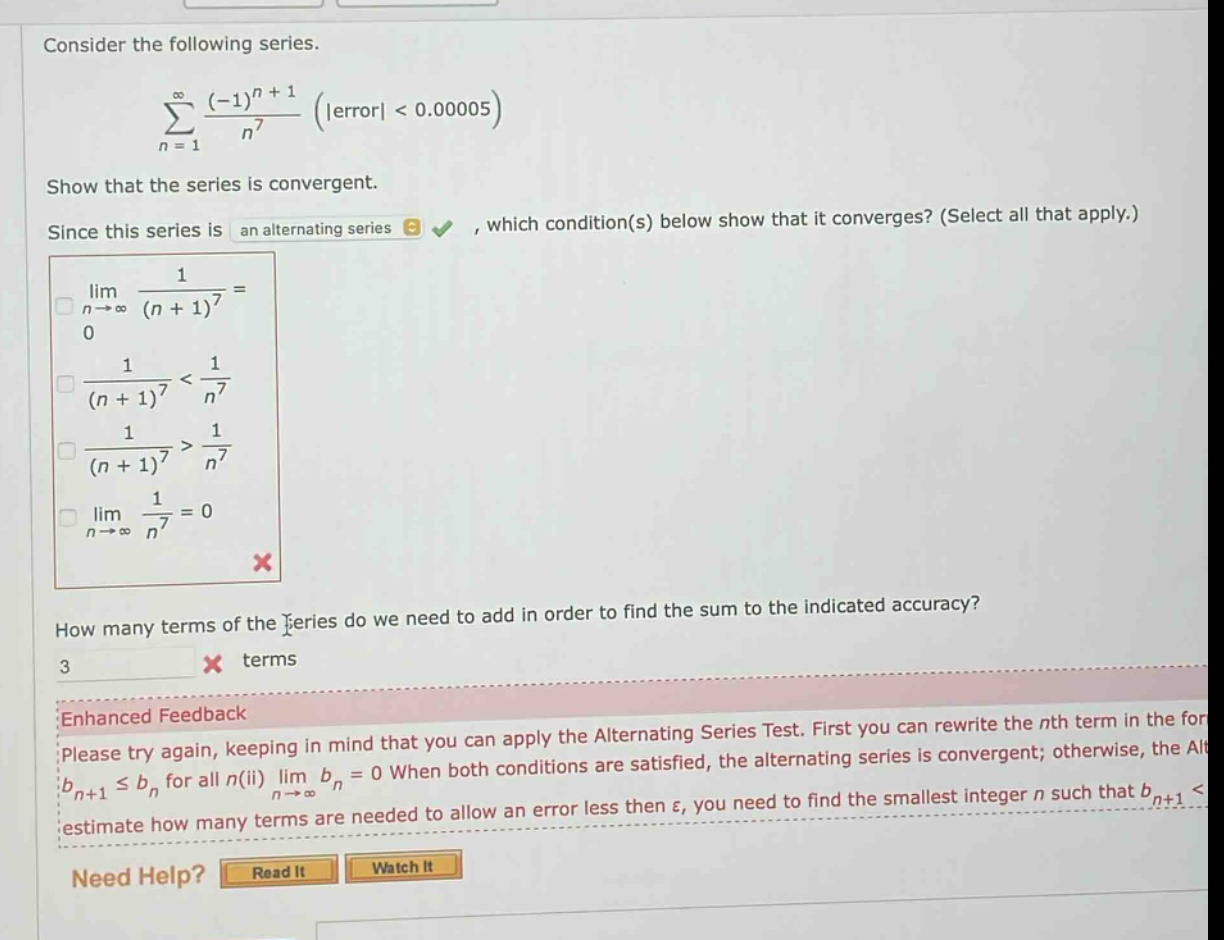
consider the following series. \n∑(n = 1 to ∞) ((-1)^(n + 1))/(n^7) (|error| < 0.00005)\nshow that the series is convergent.\nsince this series is an alternating series, which condition(s) below show that it converges? (select all that apply.)\nlim(n→∞) 1/((n + 1)^7)=0\n1/((n + 1)^7)<1/(n^7)\n1/((n + 1)^7)>1/(n^7)\nlim(n→∞) 1/(n^7)=0\nhow many terms of the series do we need to add in order to find the sum to the indicated accuracy?\nenhanced feedback\nplease try again, keeping in mind that you can apply the alternating series test. first you can rewrite the nth term in the for\nb_(n + 1)≤b_n for all n(ii) lim(n→∞) b_n = 0 when both conditions are satisfied, the alternating series is convergent; otherwise, the al\nestimate how many terms are needed to allow an error less then ε, you need to find the smallest integer n such that b_(n + 1)<\nneed help? read it watch it
Answer
Answer:
- A. $\lim_{n\rightarrow\infty}\frac{1}{(n + 1)^7}=0$; B. $\frac{1}{(n + 1)^7}<\frac{1}{n^7}$; D. $\lim_{n\rightarrow\infty}\frac{1}{n^7}=0$
- $7$ terms
Explanation:
Step1: Recall Alternating - Series Test
For an alternating series $\sum_{n = 1}^{\infty}(-1)^{n+1}b_n$ (here $b_n=\frac{1}{n^7}$), it converges if $\lim_{n\rightarrow\infty}b_n = 0$ and $b_{n + 1}\leq b_n$ for all $n$.
- $\lim_{n\rightarrow\infty}\frac{1}{n^7}=0$ and $\lim_{n\rightarrow\infty}\frac{1}{(n + 1)^7}=0$ because as $n$ goes to infinity, the denominator gets infinitely large, making the fraction approach $0$.
- Also, since $(n + 1)^7>n^7$ for $n\geq1$, we have $\frac{1}{(n + 1)^7}<\frac{1}{n^7}$.
Step2: Determine number of terms for accuracy
For an alternating series $\sum_{n = 1}^{\infty}(-1)^{n + 1}b_n$, the error $E_N$ in approximating the sum $S$ by the sum of the first $N$ terms $S_N$ is bounded by $|E_N|\leq b_{N+1}$. We want $|E_N|<0.00005$, so we set $b_{n+1}=\frac{1}{(n + 1)^7}<0.00005$. Solve the inequality $\frac{1}{(n + 1)^7}<0.00005$: $(n + 1)^7>\frac{1}{0.00005}=20000$. Take the seventh - root of both sides: $n + 1>\sqrt[7]{20000}$. $\sqrt[7]{20000}\approx7.1$. So $n+1 = 8$ and $n = 7$.