consider the following series. (sum_{k = 1}^{infty}\frac{x^{k}}{5^{k}}) (a) find the values of (x) for which…
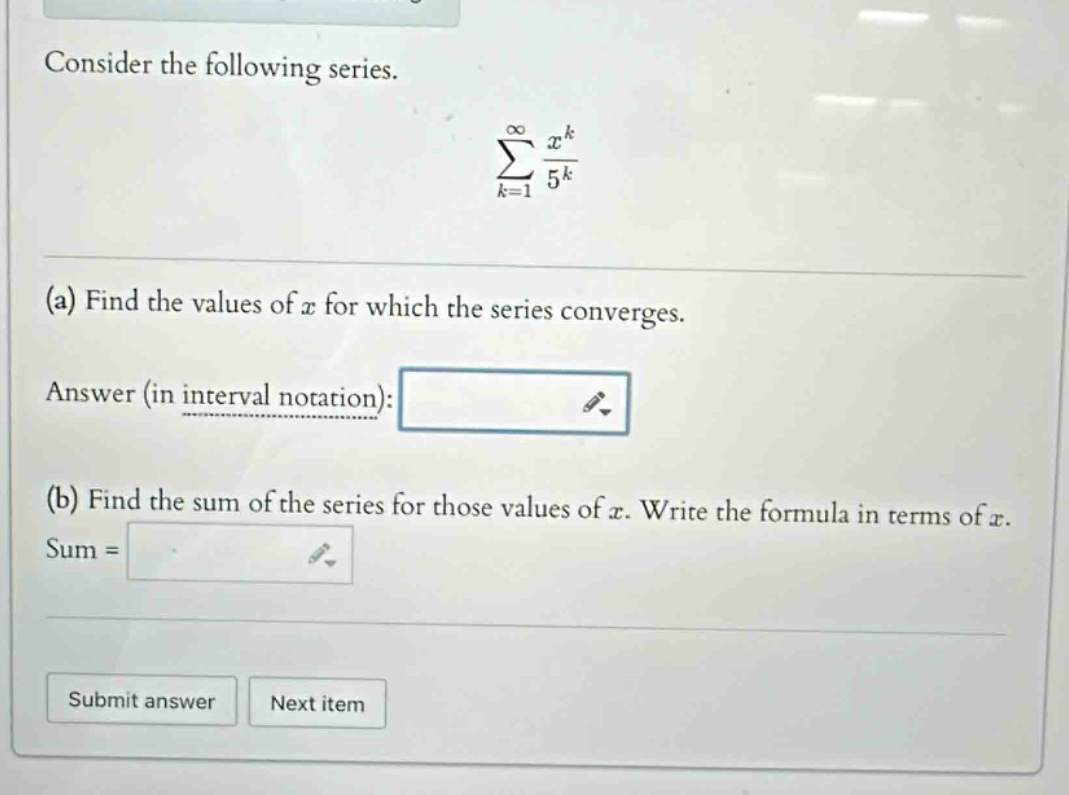
consider the following series. (sum_{k = 1}^{infty}\frac{x^{k}}{5^{k}}) (a) find the values of (x) for which the series converges. answer (in interval notation): (b) find the sum of the series for those values of (x). write the formula in terms of (x). sum =
Answer
Explanation:
Step1: Identify the series type
The series $\sum_{k = 1}^{\infty}\frac{x^{k}}{5^{k}}=\sum_{k = 1}^{\infty}(\frac{x}{5})^{k}$ is a geometric - series with first - term $a=\frac{x}{5}$ and common ratio $r=\frac{x}{5}$.
Step2: Find the convergence interval
For a geometric series $\sum_{k = 1}^{\infty}ar^{k - 1}$ (in our case, starting from $k = 1$, the general form of a geometric series starting from $k = 1$ is $\sum_{k = 1}^{\infty}ar^{k - 1}=a\frac{r}{1 - r}$ when $|r|\lt1$). Here, for convergence, we need $|r|=\left|\frac{x}{5}\right|\lt1$. Solve the inequality $\left|\frac{x}{5}\right|\lt1$:
- Case 1: $\frac{x}{5}\lt1$, then $x\lt5$.
- Case 2: $\frac{x}{5}\gt - 1$, then $x\gt - 5$. So the interval of convergence is $(-5,5)$.
Step3: Find the sum of the series
The sum of an infinite geometric series $\sum_{k = 1}^{\infty}ar^{k - 1}=\frac{a}{1 - r}$ (for $|r|\lt1$). Our series $\sum_{k = 1}^{\infty}(\frac{x}{5})^{k}$ can be written as $\sum_{k = 1}^{\infty}\frac{x}{5}(\frac{x}{5})^{k - 1}$. Here, $a=\frac{x}{5}$ and $r=\frac{x}{5}$. The sum $S=\frac{\frac{x}{5}}{1-\frac{x}{5}}=\frac{x}{5 - x}$ for $x\in(-5,5)$.
Answer:
(a) $(-5,5)$ (b) $\frac{x}{5 - x}$