consider the following series. (sum_{n = 1}^{infty}\frac{(-1)^{n}}{n^{7}}) ((vert errorvert<0.00005)) show…
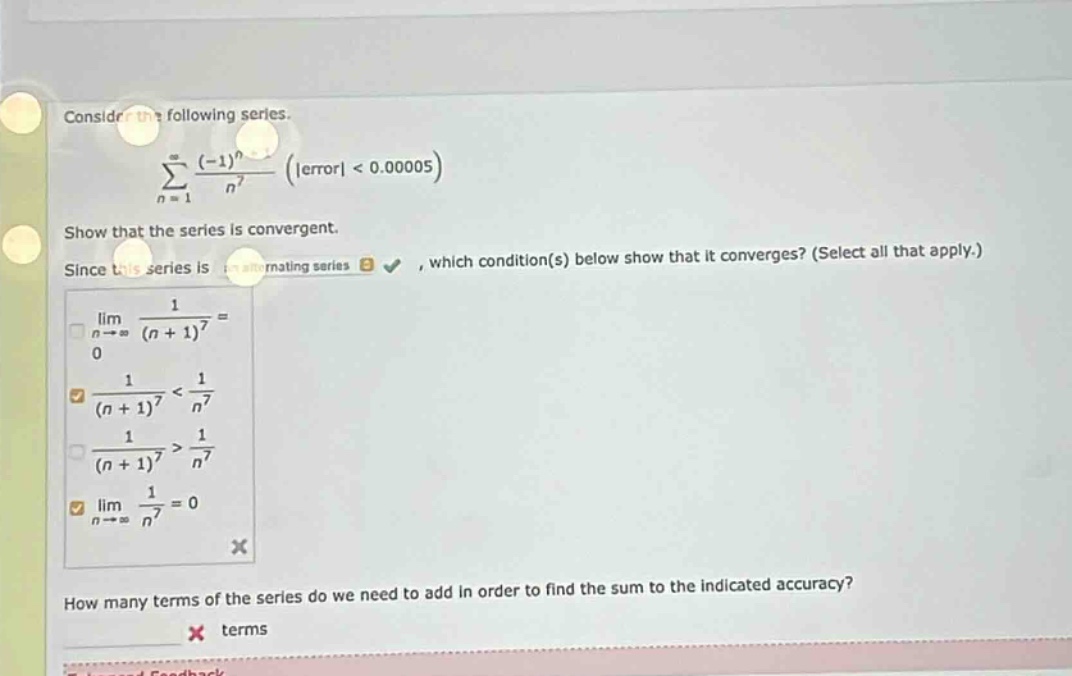
consider the following series. (sum_{n = 1}^{infty}\frac{(-1)^{n}}{n^{7}}) ((vert errorvert<0.00005)) show that the series is convergent. since this series is an alternating series, which condition(s) below show that it converges? (select all that apply.) (lim_{n\rightarrowinfty}\frac{1}{(n + 1)^{7}} = 0) (\frac{1}{(n + 1)^{7}}<\frac{1}{n^{7}}) (\frac{1}{(n + 1)^{7}}>\frac{1}{n^{7}}) (lim_{n\rightarrowinfty}\frac{1}{n^{7}} = 0) how many terms of the series do we need to add in order to find the sum to the indicated accuracy? terms
Answer
Explanation:
Step1: Recall alternating - series test
For an alternating series $\sum_{n = 1}^{\infty}(-1)^n a_n=a_1 - a_2+a_3 - a_4+\cdots$ ($a_n\gt0$), the series converges if two conditions are met: 1. $\lim_{n\rightarrow\infty}a_n = 0$; 2. $a_{n + 1}\lt a_n$ for all $n$ greater than some positive integer $N$. Here $a_n=\frac{1}{n^7}$.
Step2: Check the limit condition
We find $\lim_{n\rightarrow\infty}a_n=\lim_{n\rightarrow\infty}\frac{1}{n^7}$. As $n\rightarrow\infty$, the denominator $n^7\rightarrow\infty$, so $\lim_{n\rightarrow\infty}\frac{1}{n^7}=0$.
Step3: Check the decreasing - sequence condition
We consider the function $f(x)=\frac{1}{x^7}$, and its derivative $f^\prime(x)=-\frac{7}{x^8}\lt0$ for $x\gt0$. So $f(x)$ is a decreasing function. Then $a_{n+1}=\frac{1}{(n + 1)^7}\lt a_n=\frac{1}{n^7}$ for all $n\geq1$.
Step4: Find the number of terms for accuracy
For an alternating series $\sum_{n = 1}^{\infty}(-1)^n a_n$, the error $E_N$ in approximating the sum $S$ by the sum of the first $N$ terms $S_N$ is bounded by $|E_N|\leq a_{N + 1}$. We want $|E_N|\lt0.00005$, so we set $a_{N+1}=\frac{1}{(N + 1)^7}\lt0.00005$. Solve the inequality $\frac{1}{(N + 1)^7}\lt0.00005$: Cross - multiply to get $(N + 1)^7>\frac{1}{0.00005}=20000$. Take the seventh - root of both sides: $N + 1>\sqrt[7]{20000}$. Calculate $\sqrt[7]{20000}\approx4.7$. So $N+1\geq5$, and $N = 4$.
Answer:
The conditions that show the series converges are $\frac{1}{(n + 1)^7}\lt\frac{1}{n^7}$ and $\lim_{n\rightarrow\infty}\frac{1}{n^7}=0$. The number of terms we need to add to find the sum to the indicated accuracy is 4.