consider the function f(x)=12x^5 + 45x^4 - 200x^3 + 6. f(x) has inflection points at (reading from left to…
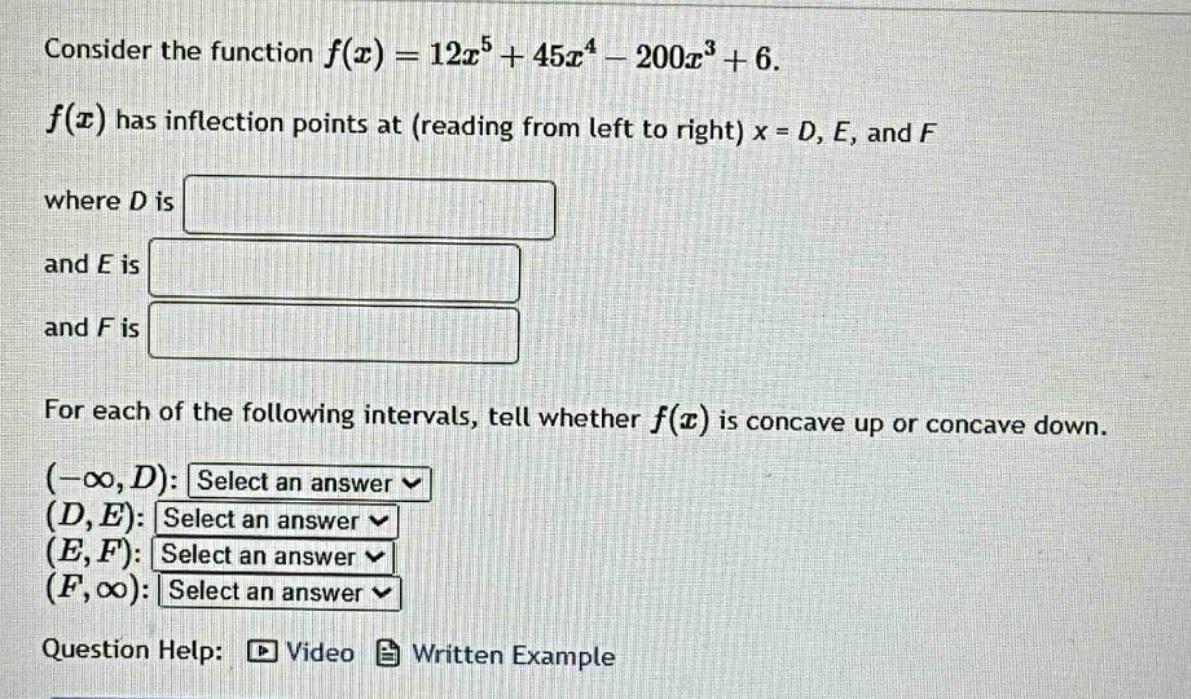
consider the function f(x)=12x^5 + 45x^4 - 200x^3 + 6. f(x) has inflection points at (reading from left to right) x = d, e, and f where d is and e is and f is for each of the following intervals, tell whether f(x) is concave up or concave down. (-∞,d): select an answer (d,e): select an answer (e,f): select an answer (f,∞): select an answer question help: video written example
Answer
Answer:
- For the inflection - points:
- First, find the first - derivative of (f(x)=12x^{5}+45x^{4}-200x^{3}+6).
- Using the power rule ((x^{n})^\prime = nx^{n - 1}), we have (f^\prime(x)=60x^{4}+180x^{3}-600x^{2}).
- Then find the second - derivative (f^{\prime\prime}(x)=240x^{3}+540x^{2}-1200x).
- Factor out (60x) from (f^{\prime\prime}(x)): (f^{\prime\prime}(x)=60x(4x^{2}+9x - 20)).
- Solve the quadratic equation (4x^{2}+9x - 20 = 0) using the quadratic formula (x=\frac{-b\pm\sqrt{b^{2}-4ac}}{2a}) for (ax^{2}+bx + c = 0). Here, (a = 4), (b = 9), and (c=-20).
- (x=\frac{-9\pm\sqrt{9^{2}-4\times4\times(-20)}}{2\times4}=\frac{-9\pm\sqrt{81 + 320}}{8}=\frac{-9\pm\sqrt{401}}{8}).
- The solutions of (f^{\prime\prime}(x)=0) are (x = 0), (x=\frac{-9+\sqrt{401}}{8}\approx\frac{-9 + 20.025}{8}=\frac{11.025}{8}=1.378), and (x=\frac{-9-\sqrt{401}}{8}\approx\frac{-9 - 20.025}{8}=\frac{-29.025}{8}=-3.628).
- Reading from left - to - right, (D=-3.628), (E = 0), (F = 1.378).
- First, find the first - derivative of (f(x)=12x^{5}+45x^{4}-200x^{3}+6).
- For the concavity intervals:
-
Choose test points in each interval:
- For the interval ((-\infty,D)=(-\infty,-3.628)), let (x=-4). Then (f^{\prime\prime}(-4)=60\times(-4)\times(4\times(-4)^{2}+9\times(-4)-20)=-240\times(64 - 36 - 20)=-240\times8<0), so (f(x)) is concave down on ((-\infty,-3.628)).
- For the interval ((D,E)=(-3.628,0)), let (x=-1). Then (f^{\prime\prime}(-1)=60\times(-1)\times(4\times(-1)^{2}+9\times(-1)-20)=-60\times(4 - 9 - 20)=-60\times(-25)>0), so (f(x)) is concave up on ((-3.628,0)).
- For the interval ((E,F)=(0,1.378)), let (x = 1). Then (f^{\prime\prime}(1)=60\times1\times(4\times1^{2}+9\times1-20)=60\times(4 + 9 - 20)=60\times(-7)<0), so (f(x)) is concave down on ((0,1.378)).
- For the interval ((F,\infty)=(1.378,\infty)), let (x = 2). Then (f^{\prime\prime}(2)=60\times2\times(4\times2^{2}+9\times2-20)=120\times(16 + 18 - 20)=120\times14>0), so (f(x)) is concave up on ((1.378,\infty)).
-
(D\approx - 3.63)
-
(E = 0)
-
(F\approx1.38)
-
((-\infty,D)): Concave down
-
((D,E)): Concave up
-
((E,F)): Concave down
-
((F,\infty)): Concave up
-
Explanation:
Step1: Find the first - derivative
Using power rule: (f^\prime(x)=60x^{4}+180x^{3}-600x^{2})
Step2: Find the second - derivative
Differentiate (f^\prime(x)): (f^{\prime\prime}(x)=240x^{3}+540x^{2}-1200x)
Step3: Factor the second - derivative
(f^{\prime\prime}(x)=60x(4x^{2}+9x - 20))
Step4: Solve (f^{\prime\prime}(x)=0)
Solve (x = 0) and (4x^{2}+9x - 20 = 0) using quadratic formula
Step5: Determine concavity
Use test points in each interval to check the sign of (f^{\prime\prime}(x))