consider the function f(x)=-2x^3 - 3x^2 + 12x. the derivative of this function is f(x)=-6x^2 - 6x + 12…
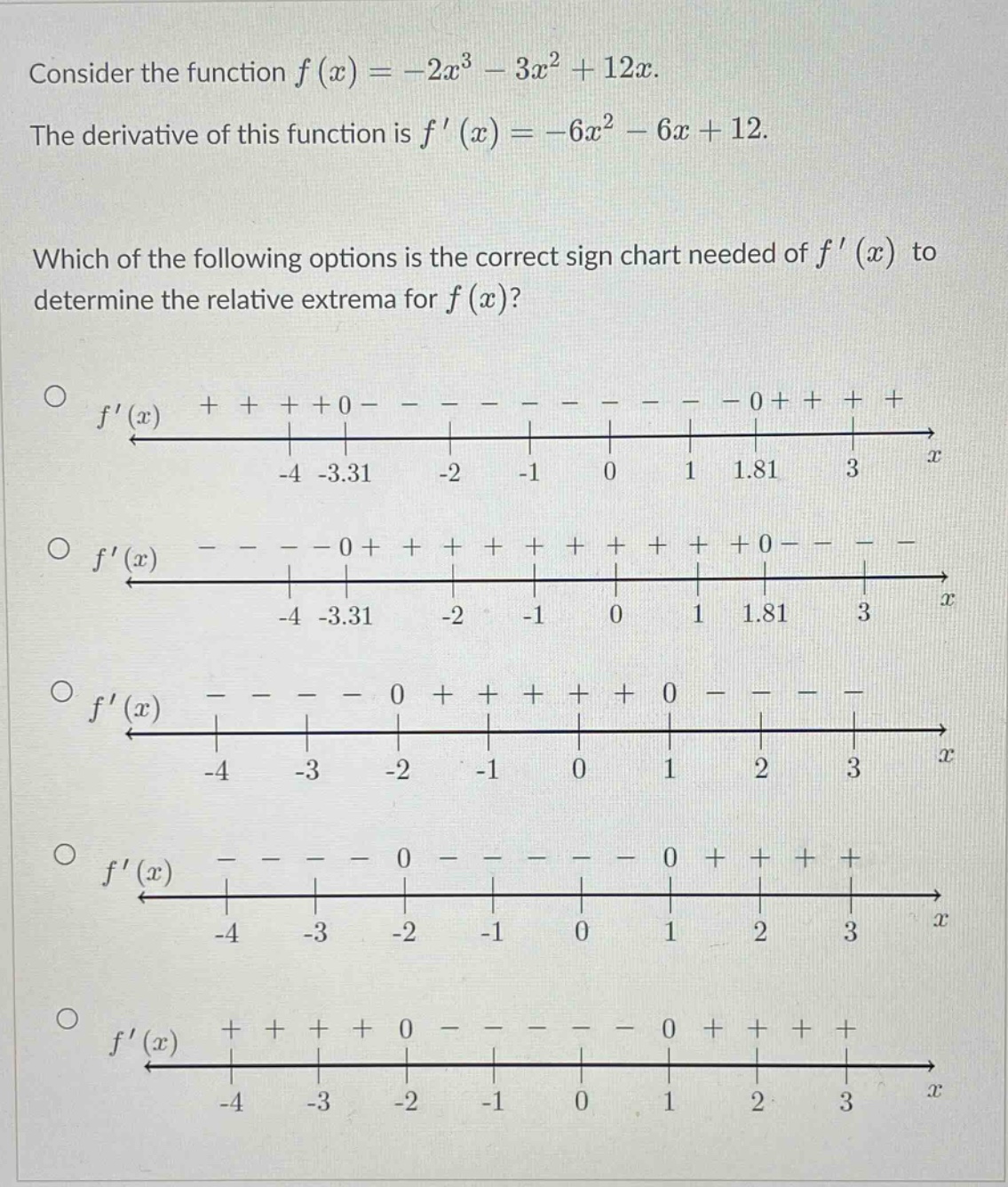
consider the function f(x)=-2x^3 - 3x^2 + 12x. the derivative of this function is f(x)=-6x^2 - 6x + 12. which of the following options is the correct sign chart needed of f(x) to determine the relative extrema for f(x)?
Answer
Explanation:
Step1: Find critical - points
Set $f'(x)=-6x^{2}-6x + 12 = 0$. Divide through by $-6$ to get $x^{2}+x - 2=0$. Factor the quadratic: $(x + 2)(x - 1)=0$. So the critical - points are $x=-2$ and $x = 1$.
Step2: Test intervals
Choose test points in the intervals $(-\infty,-2)$, $(-2,1)$, and $(1,\infty)$. For the interval $(-\infty,-2)$, let $x=-3$. Then $f'(-3)=-6\times(-3)^{2}-6\times(-3)+12=-54 + 18+12=-24<0$. For the interval $(-2,1)$, let $x = 0$. Then $f'(0)=-6\times0^{2}-6\times0 + 12=12>0$. For the interval $(1,\infty)$, let $x = 2$. Then $f'(2)=-6\times2^{2}-6\times2+12=-24-12 + 12=-24<0$.
So $f'(x)$ is negative on $(-\infty,-2)$, positive on $(-2,1)$, and negative on $(1,\infty)$.
Answer:
The correct sign - chart is: $f'(x)$: $---0++++0---$ with critical - points at $x=-2$ and $x = 1$. So the third option (where $f'(x)$ is negative on $(-\infty,-2)$, positive on $(-2,1)$, and negative on $(1,\infty)$) is correct.