consider the function f(x)=2x + 6x^(-1). for this function there are four important intervals: (-∞,a, a,b)…
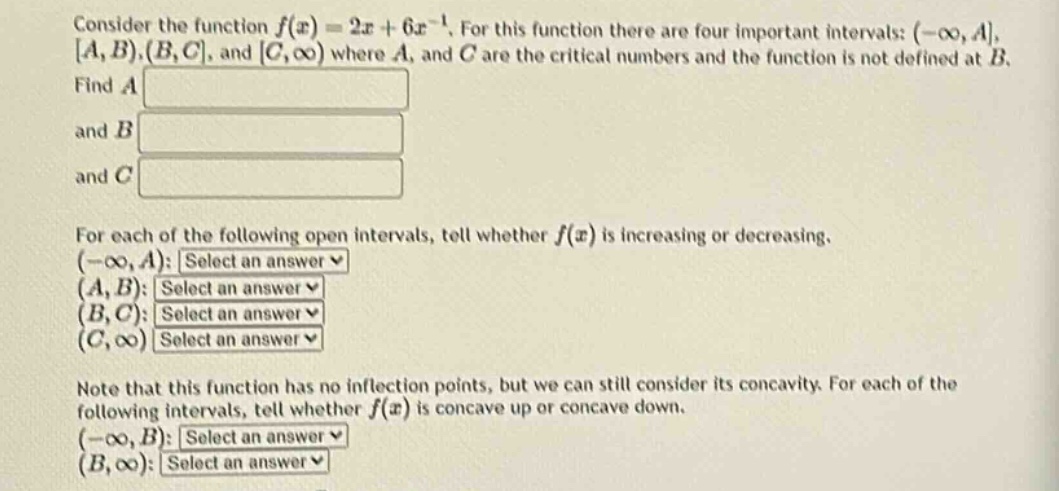
consider the function f(x)=2x + 6x^(-1). for this function there are four important intervals: (-∞,a, a,b), (b,c, and c,∞) where a, and c are the critical numbers and the function is not defined at b. find a and b and c for each of the following open intervals, tell whether f(x) is increasing or decreasing. (-∞,a): select an answer (a,b): select an answer (b,c): select an answer (c,∞) select an answer note that this function has no inflection points, but we can still consider its concavity. for each of the following intervals, tell whether f(x) is concave up or concave down. (-∞,b): select an answer (b,∞): select an answer
Answer
Explanation:
Step1: Find the derivative of the function
First, rewrite $f(x)=2x + 6x^{-1}$. Then, using the power - rule $(x^n)'=nx^{n - 1}$, we have $f'(x)=2-6x^{-2}=2-\frac{6}{x^{2}}=\frac{2x^{2}-6}{x^{2}}$.
Step2: Find the critical numbers and the point of non - definition
Set $f'(x) = 0$ to find critical numbers: $$\frac{2x^{2}-6}{x^{2}}=0$$ $2x^{2}-6 = 0$ (since $x^{2}\neq0$ when finding critical points from the numerator), then $x^{2}=3$, so $x=\pm\sqrt{3}$. The function $f(x)=2x + 6x^{-1}$ is not defined when $x = 0$. So $A=-\sqrt{3}$, $B = 0$, $C=\sqrt{3}$.
Step3: Determine the intervals of increase and decrease
We use test points in the intervals $(-\infty,-\sqrt{3})$, $(-\sqrt{3},0)$, $(0,\sqrt{3})$, and $(\sqrt{3},\infty)$. For $x=-2$ (in $(-\infty,-\sqrt{3})$), $f'(-2)=2-\frac{6}{4}=\frac{8 - 6}{4}=\frac{1}{2}>0$, so $f(x)$ is increasing on $(-\infty,-\sqrt{3})$. For $x=-1$ (in $(-\sqrt{3},0)$), $f'(-1)=2 - 6=-4<0$, so $f(x)$ is decreasing on $(-\sqrt{3},0)$. For $x = 1$ (in $(0,\sqrt{3})$), $f'(1)=2 - 6=-4<0$, so $f(x)$ is decreasing on $(0,\sqrt{3})$. For $x = 2$ (in $(\sqrt{3},\infty)$), $f'(2)=2-\frac{6}{4}=\frac{1}{2}>0$, so $f(x)$ is increasing on $(\sqrt{3},\infty)$.
Step4: Determine the concavity
Find the second - derivative $f''(x)$. Since $f'(x)=2-\frac{6}{x^{2}}$, then $f''(x)=\frac{12}{x^{3}}$. For $x=-1$ (in $(-\infty,0)$), $f''(-1)=-12<0$, so $f(x)$ is concave down on $(-\infty,0)$. For $x = 1$ (in $(0,\infty)$), $f''(1)=12>0$, so $f(x)$ is concave up on $(0,\infty)$.
Answer:
$A=-\sqrt{3}$ $B = 0$ $C=\sqrt{3}$ $(-\infty,A)$: Increasing $(A,B)$: Decreasing $(B,C)$: Decreasing $(C,\infty)$: Increasing $(-\infty,B)$: Concave down $(B,\infty)$: Concave up