consider the function $f(x)=x^{3}+2x^{2}-3$. (a) graph the function. (b) what are the x - and y - intercepts…
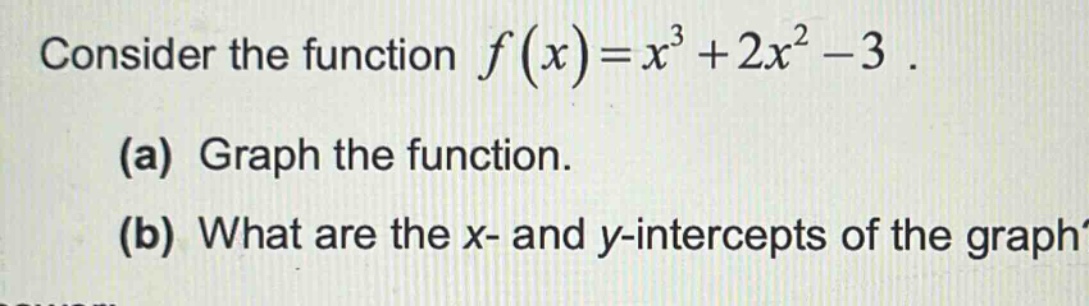
consider the function $f(x)=x^{3}+2x^{2}-3$. (a) graph the function. (b) what are the x - and y - intercepts of the graph?
Answer
Explanation:
Step1: Find y - intercept
Set $x = 0$ in $y=f(x)$. $y=0^{3}+2\times0^{2}-3=- 3$.
Step2: Find x - intercept
Set $y = 0$, so $x^{3}+2x^{2}-3 = 0$. By trial - and - error, when $x = 1$, $1^{3}+2\times1^{2}-3=1 + 2-3=0$. So $(x - 1)$ is a factor. Using polynomial long - division or synthetic division: $x^{3}+2x^{2}-3=(x - 1)(x^{2}+3x + 3)$. For the quadratic factor $x^{2}+3x + 3$, the discriminant $\Delta=b^{2}-4ac=3^{2}-4\times1\times3=9 - 12=-3<0$, so it has no real roots. The only real x - intercept is $x = 1$.
Step3: Analyze the end - behavior
As $x\to+\infty$, $y=x^{3}+2x^{2}-3\to+\infty$ since the leading term $x^{3}$ has a positive coefficient and odd degree. As $x\to-\infty$, $y=x^{3}+2x^{2}-3\to-\infty$.
Step4: Analyze the derivative
$f'(x)=3x^{2}+4x=x(3x + 4)$. Critical points are $x = 0$ and $x=-\frac{4}{3}$. $f''(x)=6x + 4$. At $x = 0$, $f''(0)=4>0$, so there is a local minimum at $x = 0$, $y=-3$. At $x=-\frac{4}{3}$, $f''(-\frac{4}{3})=-4<0$, so there is a local maximum at $x =-\frac{4}{3}$, $y=(-\frac{4}{3})^{3}+2\times(-\frac{4}{3})^{2}-3=-\frac{64}{27}+\frac{32}{9}-3=\frac{-64 + 96 - 81}{27}=-\frac{49}{27}$. We can then plot the points and sketch the graph.
Answer:
(a) Sketch the graph using the end - behavior, intercepts, and critical points found above. (b) x - intercept: $x = 1$; y - intercept: $y=-3$