3. consider the function $y = 2^{-x}+2$.\n3a find the $y$-value of the $y$-intercept of the curve $y =…
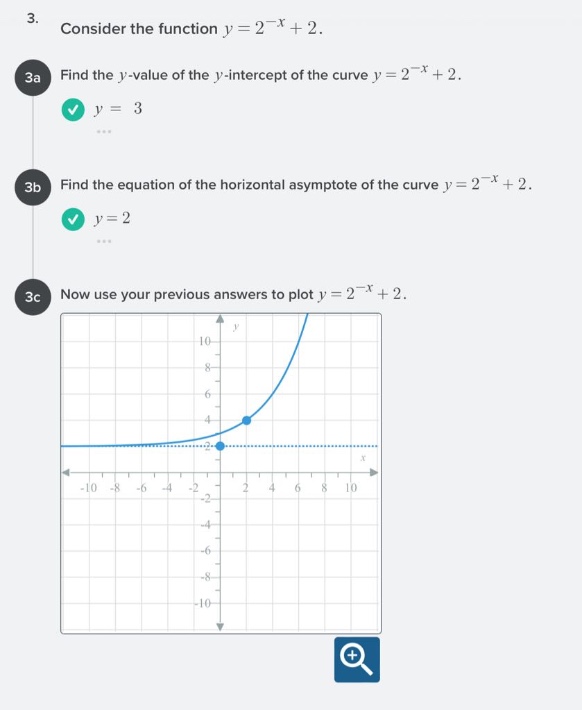
3. consider the function $y = 2^{-x}+2$.\n3a find the $y$-value of the $y$-intercept of the curve $y = 2^{-x}+2$.\n3b find the equation of the horizontal asymptote of the curve $y = 2^{-x}+2$.\n3c now use your previous answers to plot $y = 2^{-x}+2$.
Answer
Explanation:
Step1: Find y - intercept
The y - intercept occurs when $x = 0$. Substitute $x = 0$ into $y=2^{-x}+2$. So $y = 2^{-0}+2=2^{0}+2=1 + 2=3$.
Step2: Find horizontal asymptote
As $x\rightarrow+\infty$, $-x\rightarrow-\infty$. Then $\lim_{x\rightarrow+\infty}2^{-x}=\lim_{x\rightarrow+\infty}\left(\frac{1}{2}\right)^{x}=0$. So $\lim_{x\rightarrow+\infty}(2^{-x}+2)=0 + 2=2$. The equation of the horizontal asymptote is $y = 2$.
Step3: Plot the function
- Mark the y - intercept at the point $(0,3)$.
- Draw the horizontal asymptote $y = 2$ as a dashed line.
- As $x\rightarrow-\infty$, $-x\rightarrow+\infty$ and $y = 2^{-x}+2$ grows exponentially. For example, when $x=-1$, $y=2^{-(-1)}+2=2 + 2=4$. Plot a few more points and draw a smooth curve that approaches the asymptote $y = 2$ as $x\rightarrow+\infty$ and increases as $x\rightarrow-\infty$.
Answer:
For 3a: $y = 3$; For 3b: $y = 2$; For 3c: Follow the steps above to plot the function.