consider the function ( f(x)=x^{3}+0.5x - 1 ). marjan needs to graph ( f(x) ) and ( g(x)=-f(x)-3 ). his…
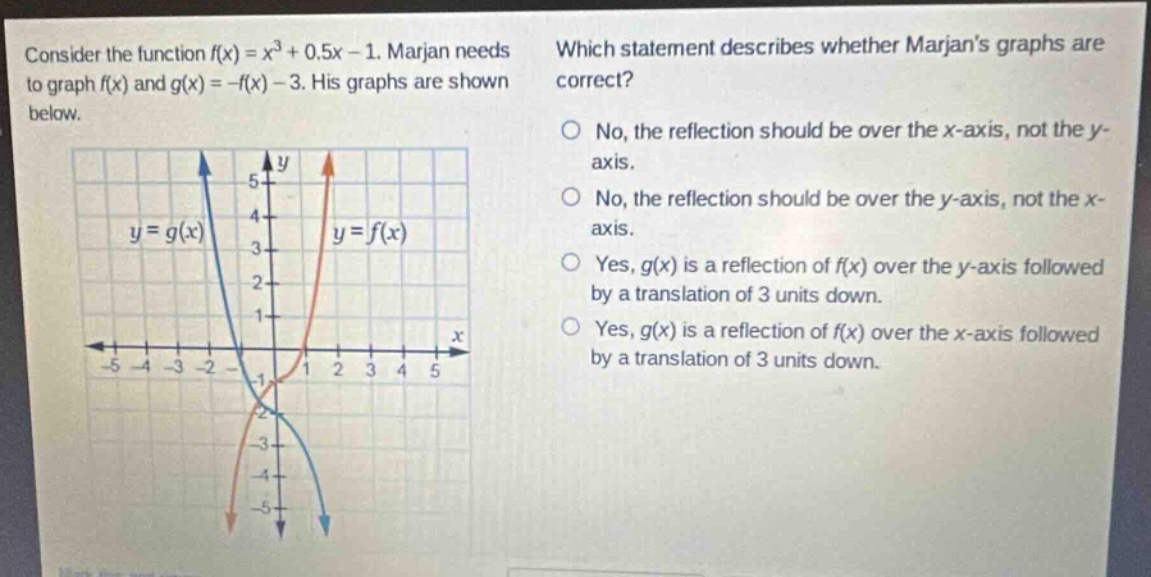
consider the function ( f(x)=x^{3}+0.5x - 1 ). marjan needs to graph ( f(x) ) and ( g(x)=-f(x)-3 ). his graphs are shown below. which statement describes whether marjans graphs are correct? no, the reflection should be over the ( x )-axis, not the ( y )-axis. no, the reflection should be over the ( y )-axis, not the ( x )-axis. yes, ( g(x) ) is a reflection of ( f(x) ) over the ( y )-axis followed by a translation of 3 units down. yes, ( g(x) ) is a reflection of ( f(x) ) over the ( x )-axis followed by a translation of 3 units down.
Answer
Explanation:
Step1: Recall transformation rules
For a function (y = f(x)), (y=-f(x)) is a reflection over the (x -)axis (since for each (x), the (y -)value is multiplied by (- 1)). And (y=-f(x)-3) is a vertical translation. After reflecting (y = f(x)) over the (x -)axis to get (y=-f(x)), then translating (y=-f(x)) down by (3) units (using the rule (y = h(x)-k) where (k = 3) and (h(x)=-f(x))) gives (y=-f(x)-3).
Answer:
Yes, (g(x)) is a reflection of (f(x)) over the (x -)axis followed by a translation of (3) units down.