consider the function y = a*cos(bx), where a > 0 and b > 0. which change affects the locations of the x…
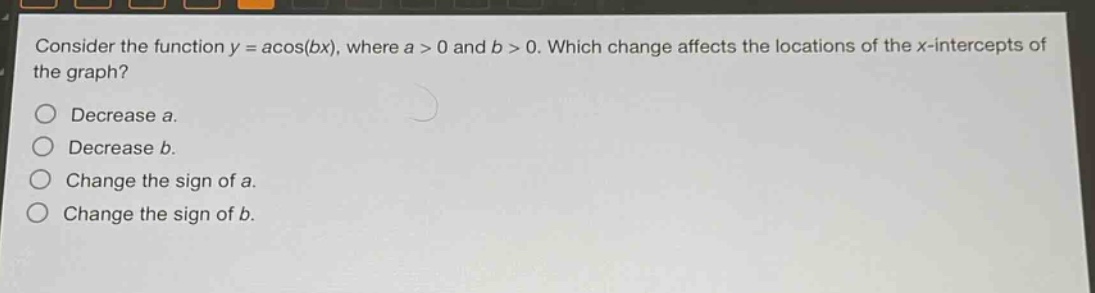
consider the function y = a*cos(bx), where a > 0 and b > 0. which change affects the locations of the x - intercepts of the graph?\ndecrease a.\ndecrease b.\nchange the sign of a.\nchange the sign of b.
Answer
Explanation:
Step1: Find x - intercepts formula
Set (y = 0), so (0=a\cos(bx)). Since (a>0), then (\cos(bx)=0). We know that (\cos\theta = 0) when (\theta=(2n + 1)\frac{\pi}{2},n\in\mathbb{Z}). So (bx=(2n + 1)\frac{\pi}{2}), and (x=\frac{(2n + 1)\pi}{2b},n\in\mathbb{Z}).
Step2: Analyze the effect of each change
- If we decrease (a), since (a) is not in the formula for (x - intercepts) ((x=\frac{(2n + 1)\pi}{2b})), it has no effect on (x - intercepts).
- If we decrease (b), from (x=\frac{(2n + 1)\pi}{2b}), as (b) gets smaller, the value of (x) gets larger. So the locations of the (x - intercepts) change.
- If we change the sign of (a), since (a) is not in the formula for (x - intercepts), it has no effect on (x - intercepts).
- If we change the sign of (b), let (b'=-b). Then (x'=\frac{(2n + 1)\pi}{2b'}=-\frac{(2n + 1)\pi}{2b}). The set of values of (x) is just the negative - valued version of the original set. The absolute - value locations of the (x - intercepts) (distance from the origin) do not change, just their signs.
Answer:
Decrease b.