consider the function $f(x)=\frac{2x + 6}{3x+3}$. for this function there are two important intervals…
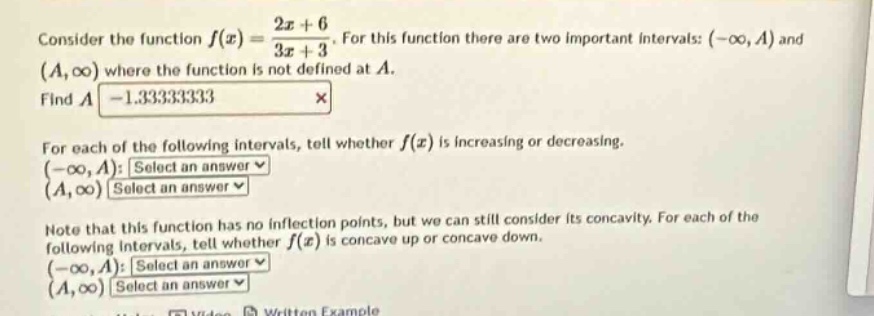
consider the function $f(x)=\frac{2x + 6}{3x+3}$. for this function there are two important intervals: $(-\\infty,a)$ and $(a,\\infty)$ where the function is not defined at $a$. find $a$ -1.333333333 $\\times$ for each of the following intervals, tell whether $f(x)$ is increasing or decreasing. $(-\\infty,a)$: select an answer $\\checkmark$ $(a,\\infty)$: select an answer $\\checkmark$ note that this function has no inflection points, but we can still consider its concavity. for each of the following intervals, tell whether $f(x)$ is concave up or concave down. $(-\\infty,a)$: select an answer $\\checkmark$ $(a,\\infty)$: select an answer $\\checkmark$
Answer
Explanation:
Step1: Find the undefined - point
A rational function $y = \frac{f(x)}{g(x)}$ is undefined when $g(x)=0$. For $f(x)=\frac{2x + 6}{3x+3}$, set $3x + 3=0$. Solve the equation $3x+3 = 0$ for $x$: Subtract 3 from both sides: $3x=-3$. Divide both sides by 3: $x=-1$. So $A=-1$.
Step2: Find the derivative of $f(x)$
Use the quotient - rule. If $y=\frac{u}{v}$, then $y^\prime=\frac{u^\prime v - uv^\prime}{v^{2}}$. Here, $u = 2x + 6$, $u^\prime=2$, $v = 3x + 3$, $v^\prime=3$. $f^\prime(x)=\frac{2(3x + 3)-(2x + 6)\times3}{(3x + 3)^{2}}=\frac{6x+6-(6x + 18)}{(3x + 3)^{2}}=\frac{6x+6 - 6x-18}{(3x + 3)^{2}}=\frac{-12}{(3x + 3)^{2}}$.
Step3: Determine increasing and decreasing intervals
The sign of $f^\prime(x)$ determines if the function is increasing or decreasing. Since $(3x + 3)^{2}>0$ for all $x\neq - 1$ and $f^\prime(x)=\frac{-12}{(3x + 3)^{2}}<0$ for all $x\neq - 1$. For the interval $(-\infty,-1)$ and $(-1,\infty)$, $f(x)$ is decreasing on both $(-\infty,-1)$ and $(-1,\infty)$.
Step4: Find the second - derivative of $f(x)$
Use the quotient - rule again on $f^\prime(x)=\frac{-12}{(3x + 3)^{2}}=-12(3x + 3)^{-2}$. Let $u=-12$, $u^\prime = 0$, $v=(3x + 3)^{2}$, $v^\prime=2\times3\times(3x + 3)=6(3x + 3)$. $f^{\prime\prime}(x)=\frac{0\times(3x + 3)^{2}-(-12)\times6(3x + 3)}{(3x + 3)^{4}}=\frac{72(3x + 3)}{(3x + 3)^{4}}=\frac{72}{(3x + 3)^{3}}$.
Step5: Determine concavity
For the interval $(-\infty,-1)$: Let $x=-2$, then $f^{\prime\prime}(-2)=\frac{72}{(-6 + 3)^{3}}=\frac{72}{-27}<0$, so $f(x)$ is concave down on $(-\infty,-1)$. For the interval $(-1,\infty)$: Let $x = 0$, then $f^{\prime\prime}(0)=\frac{72}{(0 + 3)^{3}}=\frac{72}{27}>0$, so $f(x)$ is concave up on $(-1,\infty)$.
Answer:
$A=-1$; $(-\infty,-1)$: Decreasing, Concave down; $(-1,\infty)$: Decreasing, Concave up.