consider the function f(x)=7(x - 2)^(2/3). for this function there are two important intervals: and (a,∞)…
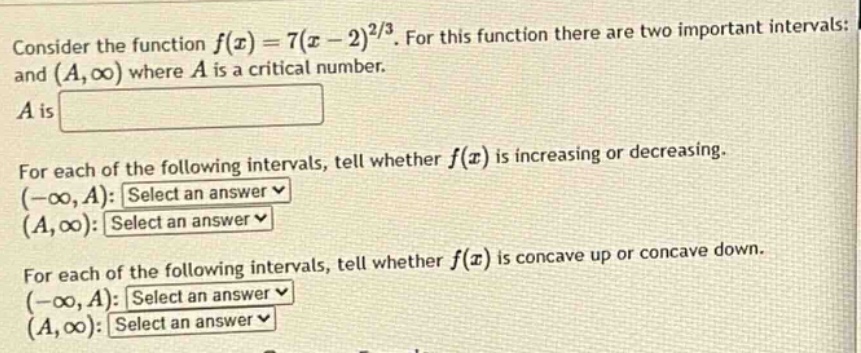
consider the function f(x)=7(x - 2)^(2/3). for this function there are two important intervals: and (a,∞) where a is a critical number. a is for each of the following intervals, tell whether f(x) is increasing or decreasing. (-∞,a): select an answer (a,∞): select an answer for each of the following intervals, tell whether f(x) is concave up or concave down. (-∞,a): select an answer (a,∞): select an answer
Answer
Explanation:
Step1: Find the derivative of $f(x)$
Using the chain - rule, if $y = 7u^{2/3}$ and $u=x - 2$, then $\frac{dy}{du}=7\times\frac{2}{3}u^{-1/3}=\frac{14}{3}(x - 2)^{-1/3}$ and $\frac{du}{dx}=1$. So $f^\prime(x)=\frac{14}{3(x - 2)^{1/3}}$.
Step2: Find the critical number
Set $f^\prime(x)=0$ or $f^\prime(x)$ is undefined. Since $\frac{14}{3(x - 2)^{1/3}} = 0$ has no solution, and $f^\prime(x)$ is undefined when $x - 2=0$, so $x = 2$. Thus $A = 2$.
Step3: Determine increasing and decreasing intervals
For $x\in(-\infty,2)$, let's take a test - point, say $x = 1$. Then $f^\prime(1)=\frac{14}{3(1 - 2)^{1/3}}=-\frac{14}{3}<0$, so $f(x)$ is decreasing on $(-\infty,2)$. For $x\in(2,\infty)$, let's take a test - point, say $x = 3$. Then $f^\prime(3)=\frac{14}{3(3 - 2)^{1/3}}=\frac{14}{3}>0$, so $f(x)$ is increasing on $(2,\infty)$.
Step4: Find the second - derivative of $f(x)$
Using the quotient rule, if $y=\frac{14}{3(x - 2)^{1/3}}=\frac{14}{3}(x - 2)^{-1/3}$, then $y^\prime=f^{\prime\prime}(x)=-\frac{14}{9}(x - 2)^{-4/3}=-\frac{14}{9(x - 2)^{4/3}}$. Since $(x - 2)^{4/3}>0$ for all $x\neq2$, $f^{\prime\prime}(x)<0$ for all $x\neq2$. So $f(x)$ is concave down on $(-\infty,2)$ and $(2,\infty)$.
Answer:
$A = 2$ $(-\infty,2)$: Decreasing $(2,\infty)$: Increasing $(-\infty,2)$: Concave down $(2,\infty)$: Concave down