consider the function in the graph to the right. the function has a relative maximum of at x = the function…
consider the function in the graph to the right. the function has a relative maximum of at x = the function has a relative minimum of at x = the function is increasing on the interval(s): the function is decreasing on the interval(s): the domain of the function is: the range of the function is: question help: video submit question
Answer
Explanation:
Step1: Identify relative maximum
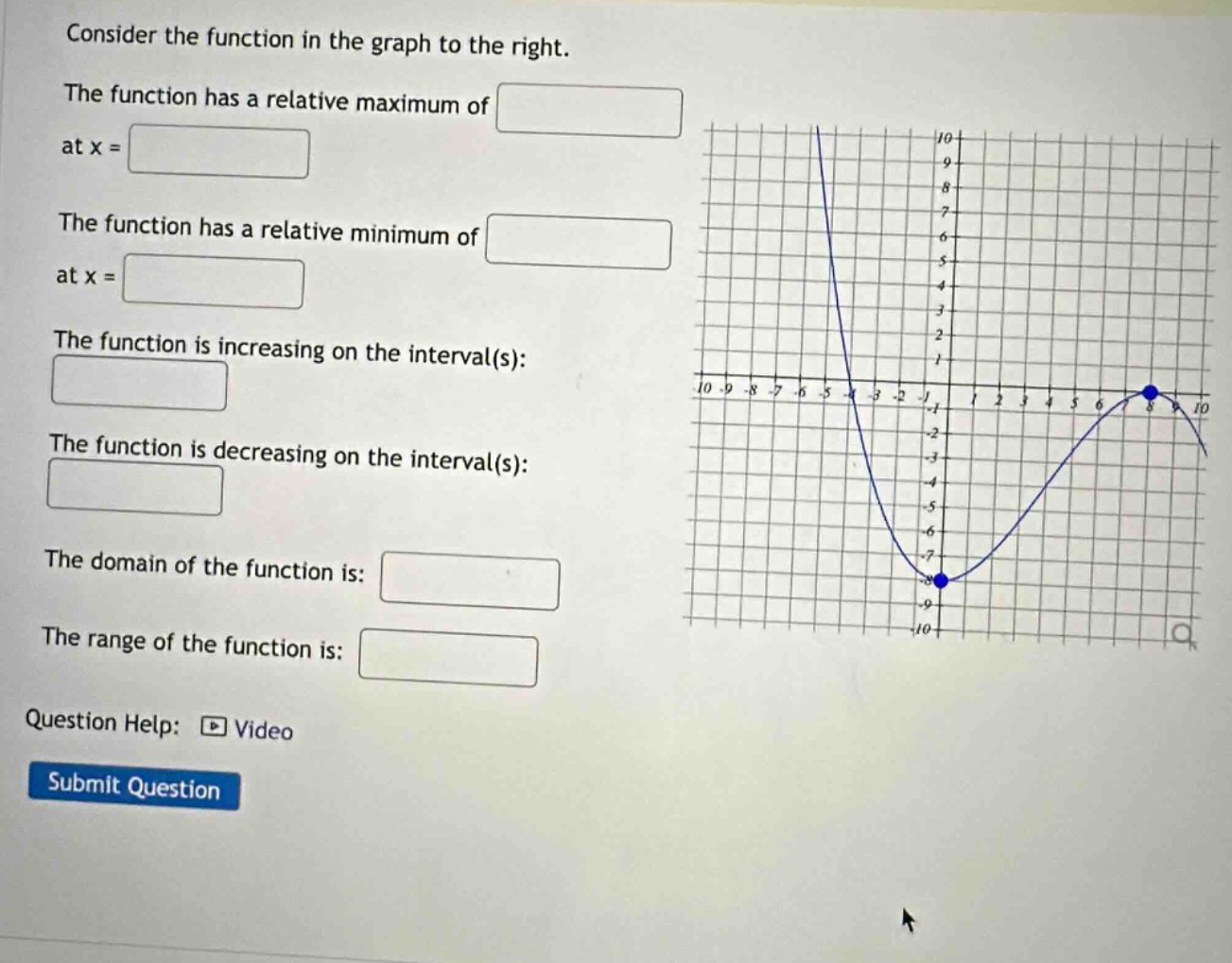
The highest - point in a local region of the graph gives the relative maximum. By observing the graph, the relative maximum value of the function is 7 and it occurs at (x = 8).
Step2: Identify relative minimum
The lowest - point in a local region of the graph gives the relative minimum. By observing the graph, the relative minimum value of the function is - 8 and it occurs at (x=-2).
Step3: Determine increasing intervals
The function is increasing when the graph goes up from left to right. The function is increasing on the intervals ((-2,8)).
Step4: Determine decreasing intervals
The function is decreasing when the graph goes down from left to right. The function is decreasing on the intervals ((-\infty,-2)\cup(8,\infty)).
Step5: Find the domain
The domain is the set of all (x) - values for which the function is defined. Since the graph extends infinitely in both the left and right directions, the domain is ((-\infty,\infty)).
Step6: Find the range
The range is the set of all (y) - values for which the function is defined. The lowest (y) - value is - 8 and the graph extends upwards without bound, so the range is ([-8,\infty)).
Answer:
The function has a relative maximum of 7 at (x = 8). The function has a relative minimum of - 8 at (x=-2). The function is increasing on the interval(s): ((-2,8)). The function is decreasing on the interval(s): ((-\infty,-2)\cup(8,\infty)). The domain of the function is: ((-\infty,\infty)). The range of the function is: ([-8,\infty)).