consider the function y = ln(x - 4). select all characteristics that correctly describe the function. there…
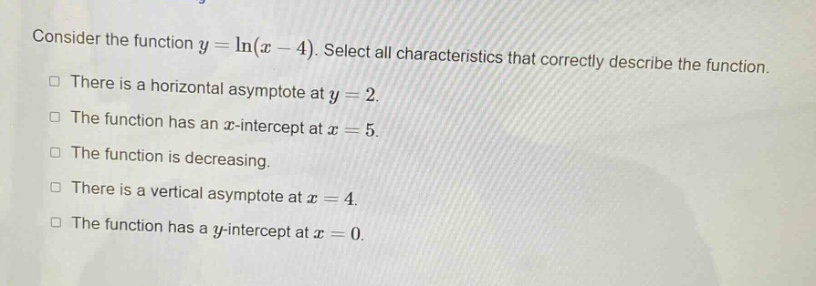
consider the function y = ln(x - 4). select all characteristics that correctly describe the function. there is a horizontal asymptote at y = 2. the function has an x - intercept at x = 5. the function is decreasing. there is a vertical asymptote at x = 4. the function has a y - intercept at x = 0.
Answer
Explanation:
Step1: Analyze horizontal asymptote
The natural - logarithm function $y = \ln(u)$ has no horizontal asymptote. As $x\to+\infty$, $\ln(x - 4)\to+\infty$ and as $x\to4^{+}$, $\ln(x - 4)\to-\infty$. So the statement "There is a horizontal asymptote at $y = 2$" is false.
Step2: Find x - intercept
Set $y=0$. Then $\ln(x - 4)=0$. Since $\ln a=0$ when $a = 1$, we have $x-4 = 1$, so $x=5$. The statement "The function has an $x$-intercept at $x = 5$" is true.
Step3: Analyze the slope
The derivative of $y=\ln(x - 4)$ using the chain - rule. If $y=\ln(u)$ and $u=x - 4$, then $y^\prime=\frac{1}{u}\cdot u^\prime=\frac{1}{x - 4}$. For $x>4$, $y^\prime=\frac{1}{x - 4}>0$, so the function is increasing, not decreasing. The statement "The function is decreasing" is false.
Step4: Analyze vertical asymptote
The domain of $y = \ln(x - 4)$ is $x>4$. As $x\to4^{+}$, $\lim_{x\to4^{+}}\ln(x - 4)=-\infty$. So there is a vertical asymptote at $x = 4$. The statement "There is a vertical asymptote at $x = 4$" is true.
Step5: Find y - intercept
To find the $y$-intercept, set $x = 0$. But the function $y=\ln(x - 4)$ is not defined for $x = 0$ since $x-4=-4<0$ and the natural - logarithm function $\ln(u)$ is only defined for $u>0$. So the statement "The function has a $y$-intercept at $x = 0$" is false.
Answer:
The function has an $x$-intercept at $x = 5$. There is a vertical asymptote at $x = 4$.