8. consider the function (y = -log_{3}(x + 3)).\n8a solve for the (x) - coordinate of the (x)…
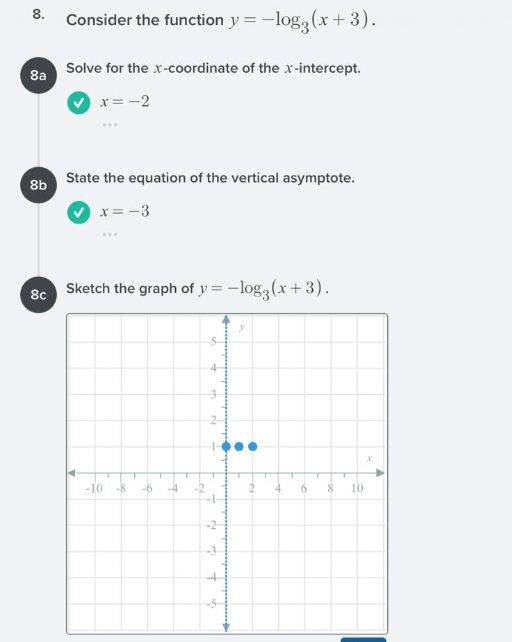
8. consider the function (y = -log_{3}(x + 3)).\n8a solve for the (x) - coordinate of the (x) - intercept.\n8b state the equation of the vertical asymptote.\n8c sketch the graph of (y = -log_{3}(x + 3)).
Answer
Explanation:
Step1: Recall x - intercept concept
Set (y = 0) in (y=-\log_3(x + 3)). So, (0=-\log_3(x + 3)), which implies (\log_3(x + 3)=0).
Step2: Use log - exponential conversion
By the definition of logarithms, if (\log_a b=c), then (b=a^c). Here (a = 3), (c = 0), so (x+3=3^0). Since (3^0 = 1), we have (x+3=1), and (x=1 - 3=-2).
Step3: Recall vertical asymptote for log functions
For the function (y=\log_a(u)), the vertical asymptote is at (u = 0). In (y=-\log_3(x + 3)), set (x+3=0), and we get (x=-3) as the vertical asymptote.
Step4: Sketch the graph
- The x - intercept is at (x=-2), so the graph passes through the point ((-2,0)).
- The vertical asymptote is (x=-3).
- The parent function of (y =-\log_3(x + 3)) is (y=\log_3x). The negative sign reflects the graph of (y = \log_3x) about the x - axis, and the (x+3) inside the logarithm shifts the graph 3 units to the left. As (x\to - 3^+), (y\to+\infty), and as (x\to+\infty), (y\to-\infty).
Answer:
8a. (x=-2) 8b. (x=-3) 8c. Graph has x - intercept at ((-2,0)), vertical asymptote (x = - 3), is a reflection about the x - axis and a left - shift of the parent function (y=\log_3x).