8. consider the function f(x) = 3 sin(2x). what is the period of the function? (lesson 18.1) (0.5 point) a…
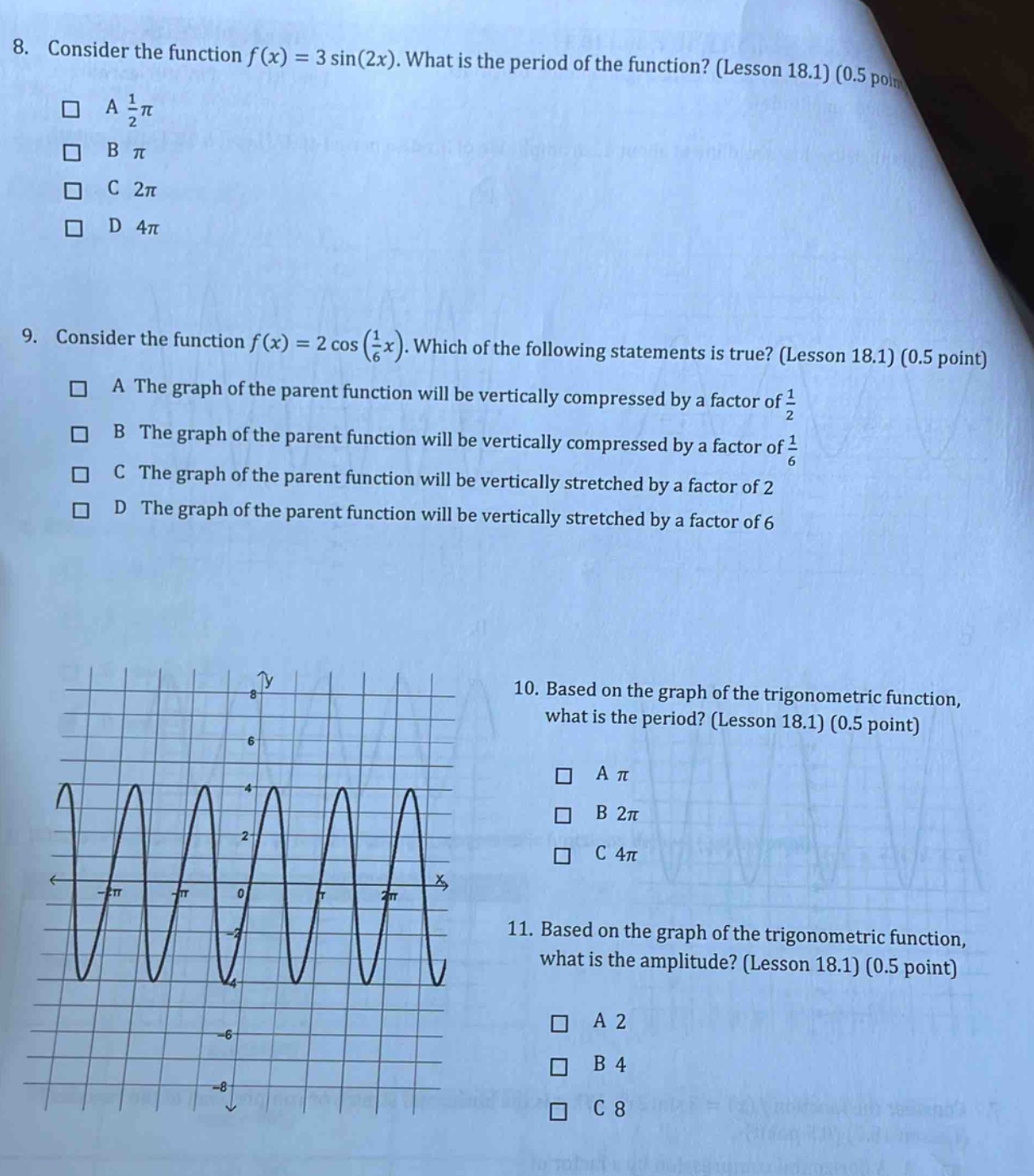
8. consider the function f(x) = 3 sin(2x). what is the period of the function? (lesson 18.1) (0.5 point) a 1/2π b π c 2π d 4π 9. consider the function f(x) = 2 cos(1/6x). which of the following statements is true? (lesson 18.1) (0.5 point) a the graph of the parent function will be vertically compressed by a factor of 1/2 b the graph of the parent function will be vertically compressed by a factor of 1/6 c the graph of the parent function will be vertically stretched by a factor of 2 d the graph of the parent function will be vertically stretched by a factor of 6 10. based on the graph of the trigonometric function, what is the period? (lesson 18.1) (0.5 point) a π b 2π c 4π 11. based on the graph of the trigonometric function, what is the amplitude? (lesson 18.1) (0.5 point) a 2 b 4 c 8
Answer
Explanation:
Step1: Recall period formula for $y = A\sin(Bx)$
The period of $y = A\sin(Bx)$ is $T=\frac{2\pi}{|B|}$. For $f(x)=3\sin(2x)$, $B = 2$.
Step2: Calculate the period
$T=\frac{2\pi}{|2|}=\pi$.
Answer:
B. $\pi$
Explanation:
Step1: Analyze vertical - stretch/compression for $y = A\cos(Bx)$
For the function $y = A\cos(Bx)$, the coefficient $A$ determines vertical stretch or compression. For $f(x)=2\cos(\frac{1}{6}x)$, $A = 2$. When $|A|> 1$, the graph of the parent - function $y=\cos(x)$ is vertically stretched by a factor of $|A|$. Here, $A = 2$, so the graph of the parent function is vertically stretched by a factor of 2.
Answer:
D. The graph of the parent function will be vertically stretched by a factor of 2
Explanation:
Step1: Identify period from the graph
The period is the horizontal distance between two consecutive identical points on the graph. Looking at the graph, we can see that the distance between two consecutive peaks (or troughs) is $\pi$.
Answer:
A. $\pi$
Explanation:
Step1: Recall amplitude definition
The amplitude of a trigonometric function is half the vertical distance between the maximum and minimum values of the function. From the graph, the maximum value is 4 and the minimum value is - 4. The vertical distance between them is $4-(-4)=8$, and the amplitude is $\frac{8}{2}=4$.
Answer:
B. 4