consider the function f(x)=6 sin(x - π/8)+8. what transformation results in g(x)=6 sin(x - 7π/16)+1…
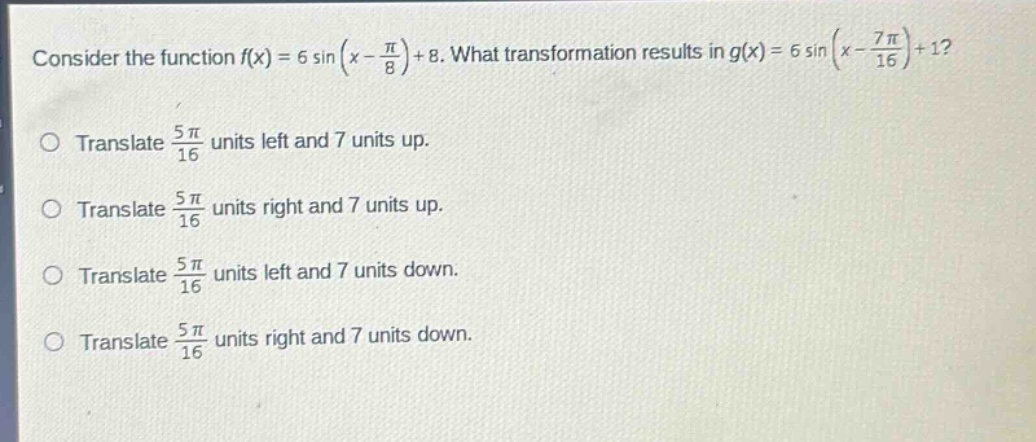
consider the function f(x)=6 sin(x - π/8)+8. what transformation results in g(x)=6 sin(x - 7π/16)+1? translate 5π/16 units left and 7 units up. translate 5π/16 units right and 7 units up. translate 5π/16 units left and 7 units down. translate 5π/16 units right and 7 units down.
Answer
Explanation:
Step1: Analyze horizontal - shift
For a sine function (y = A\sin(B(x - h))+k), the horizontal - shift is determined by the change in the (x) - value inside the sine function. The original function is (f(x)=6\sin(x-\frac{\pi}{8}) + 8) and the new function is (g(x)=6\sin(x-\frac{7\pi}{16})+1). We find the difference in the phase - shift values: ((x-\frac{7\pi}{16})-(x - \frac{\pi}{8})=x-\frac{7\pi}{16}-x+\frac{\pi}{8}=\frac{\pi}{8}-\frac{7\pi}{16}=\frac{2\pi - 7\pi}{16}=-\frac{5\pi}{16}). A negative difference means a left - shift of (\frac{5\pi}{16}) units.
Step2: Analyze vertical - shift
The vertical - shift is determined by the change in the constant term outside the sine function. The original function has a constant term (k_1 = 8) and the new function has a constant term (k_2 = 1). The change in the vertical value is (1 - 8=-7). A negative change means a downward shift of 7 units.
Answer:
Translate (\frac{5\pi}{16}) units left and 7 units down.