consider the function f(x) = {-(x + 5)/(x + 3), x < -2; x^3 + 6, x >= -2. which statement describes whether…
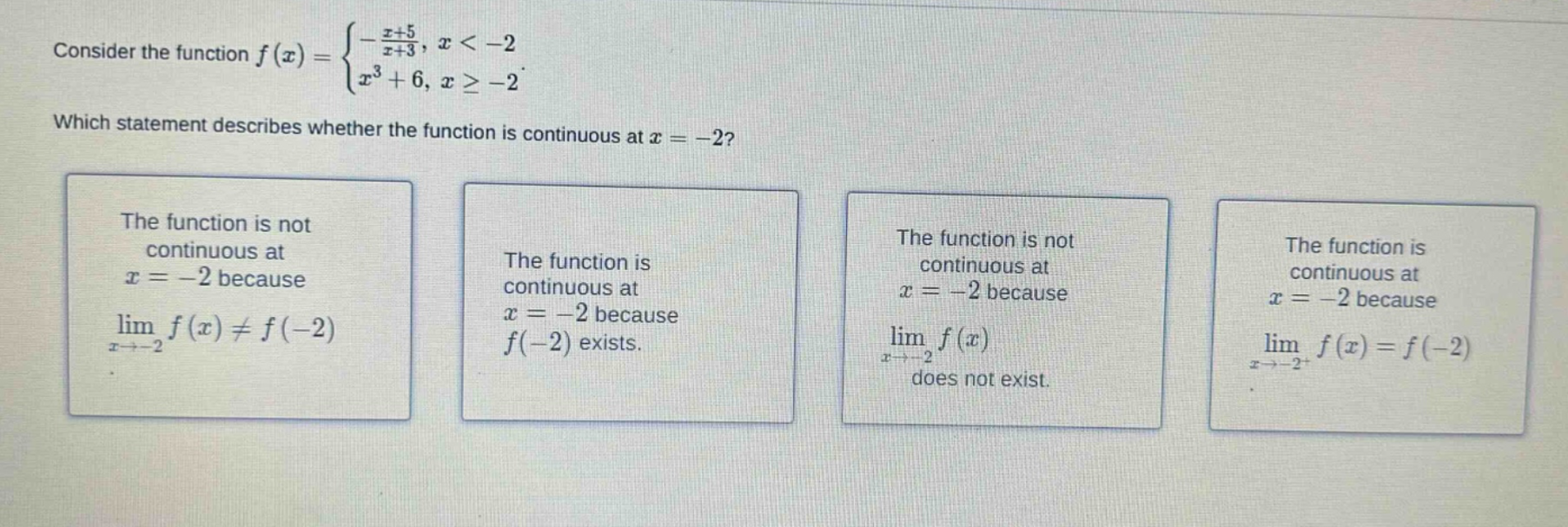
consider the function f(x) = {-(x + 5)/(x + 3), x < -2; x^3 + 6, x >= -2. which statement describes whether the function is continuous at x = -2? the function is not continuous at x = -2 because lim(x -> -2) f(x) != f(-2). the function is continuous at x = -2 because f(-2) exists. the function is not continuous at x = -2 because lim(x -> -2) f(x) does not exist. the function is continuous at x = -2 because lim(x -> -2) f(x) = f(-2).
Answer
Explanation:
Step1: Calculate left - hand limit
For (x\lt - 2), (f(x)=-\frac{x + 5}{x+3}). (\lim_{x\rightarrow - 2^{-}}f(x)=\lim_{x\rightarrow - 2^{-}}-\frac{x + 5}{x + 3}=-\frac{-2 + 5}{-2+3}=-3)
Step2: Calculate right - hand limit
For (x\geq - 2), (f(x)=x^{3}+6). (\lim_{x\rightarrow - 2^{+}}f(x)=\lim_{x\rightarrow - 2^{+}}(x^{3}+6)=(-2)^{3}+6=-8 + 6=-2)
Step3: Calculate (f(-2))
Since (x=-2) and (x\geq - 2), (f(-2)=(-2)^{3}+6=-2)
Step4: Check continuity condition
A function (y = f(x)) is continuous at (x = a) if (\lim_{x\rightarrow a^{-}}f(x)=\lim_{x\rightarrow a^{+}}f(x)=f(a)). Here (\lim_{x\rightarrow - 2^{-}}f(x)=-3), (\lim_{x\rightarrow - 2^{+}}f(x)=-2), and (f(-2)=-2). Since (\lim_{x\rightarrow - 2^{-}}f(x)\neq\lim_{x\rightarrow - 2^{+}}f(x)), (\lim_{x\rightarrow - 2}f(x)) does not exist.
Answer:
The function is not continuous at (x=-2) because (\lim_{x\rightarrow - 2}f(x)) does not exist.