consider the function f(x)=5 tan^(-1)(x^2). a. differentiate the taylor series centered at 0 for f(x). b…
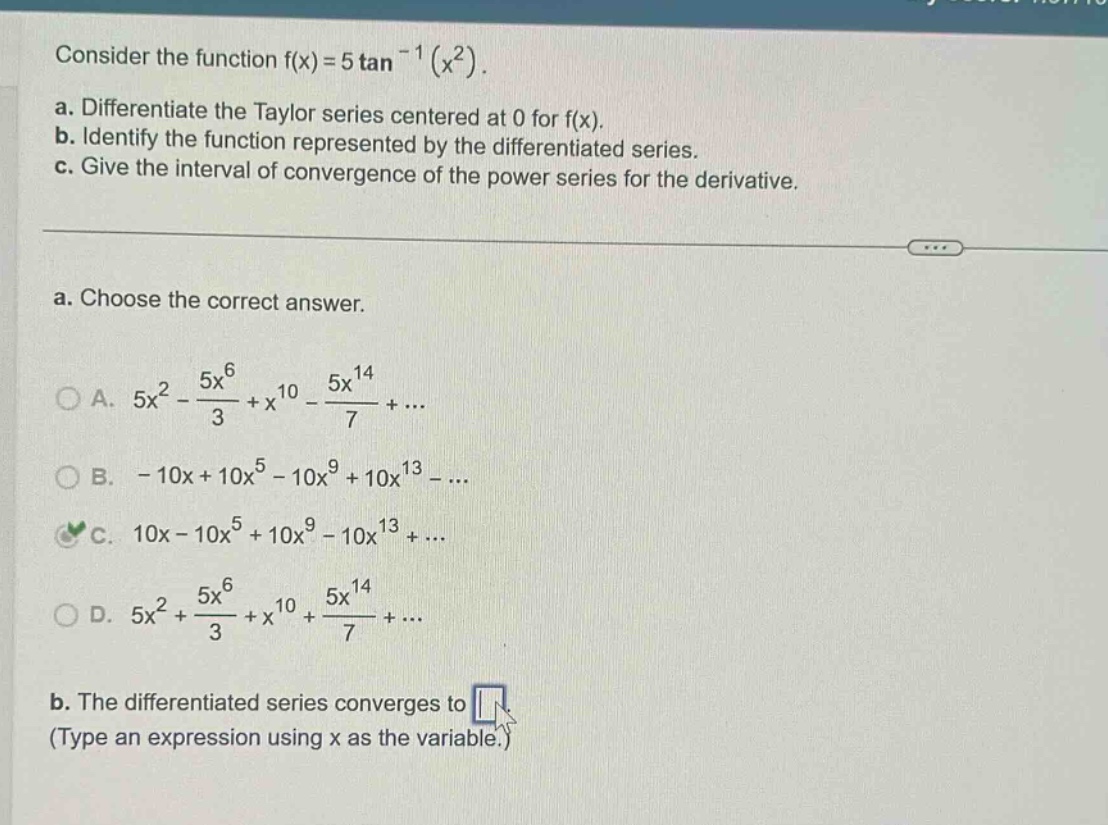
consider the function f(x)=5 tan^(-1)(x^2). a. differentiate the taylor series centered at 0 for f(x). b. identify the function represented by the differentiated series. c. give the interval of convergence of the power series for the derivative. a. choose the correct answer. a. 5x^2 - 5x^6/3 + x^10 - 5x^14/7 + ... b. - 10x + 10x^5 - 10x^9 + 10x^13 - ... c. 10x - 10x^5 + 10x^9 - 10x^13 + ... d. 5x^2 + 5x^6/3 + x^10 + 5x^14/7 + ... b. the differentiated series converges to (type an expression using x as the variable.)
Answer
Explanation:
Step1: Recall the Taylor - series of $\tan^{-1}(u)$
The Taylor - series of $\tan^{-1}(u)$ centered at $u = 0$ is $\tan^{-1}(u)=\sum_{n = 0}^{\infty}\frac{(-1)^{n}}{2n + 1}u^{2n+1}=u-\frac{u^{3}}{3}+\frac{u^{5}}{5}-\frac{u^{7}}{7}+\cdots$, for $|u|\lt1$. Let $u = x^{2}$, then $f(x)=5\tan^{-1}(x^{2})=5\sum_{n = 0}^{\infty}\frac{(-1)^{n}}{2n + 1}(x^{2})^{2n+1}=5\sum_{n = 0}^{\infty}\frac{(-1)^{n}}{2n + 1}x^{4n + 2}$.
Step2: Differentiate the Taylor - series of $f(x)$
Using the power - rule for differentiation $\frac{d}{dx}(x^{m})=mx^{m - 1}$, we have: [ \begin{align*} f^\prime(x)&=\frac{d}{dx}\left(5\sum_{n = 0}^{\infty}\frac{(-1)^{n}}{2n + 1}x^{4n+2}\right)\ &=5\sum_{n = 0}^{\infty}\frac{(-1)^{n}(4n + 2)}{2n + 1}x^{4n+1}\ &=10\sum_{n = 0}^{\infty}(-1)^{n}x^{4n + 1}=10x-10x^{5}+10x^{9}-10x^{13}+\cdots \end{align*} ] So the answer for part (a) is C.
Step3: Identify the function represented by the differentiated series
We know that the geometric series formula is $\sum_{n = 0}^{\infty}ar^{n}=\frac{a}{1 - r}$, for $|r|\lt1$. The series $10\sum_{n = 0}^{\infty}(-1)^{n}x^{4n+1}=10x\sum_{n = 0}^{\infty}(-x^{4})^{n}$. Here, $a = 1$ and $r=-x^{4}$. So the sum of the series is $\frac{10x}{1 + x^{4}}$.
Step4: Find the interval of convergence of the power series for the derivative
For the geometric series $\sum_{n = 0}^{\infty}ar^{n}=\frac{a}{1 - r}$, the series converges when $|r|\lt1$. In our case, $r=-x^{4}$, so we need $|-x^{4}|\lt1$, which simplifies to $|x|\lt1$. When $x = 1$, the series becomes $10\sum_{n = 0}^{\infty}(-1)^{n}$, which diverges (it is an alternating series that does not converge by the divergence test since $\lim_{n\rightarrow\infty}(-1)^{n}$ does not exist). When $x=-1$, the series becomes $10\sum_{n = 0}^{\infty}(-1)^{n}(-1)^{4n + 1}=10\sum_{n = 0}^{\infty}(-1)^{5n+1}$, which also diverges.
Answer:
a. C. $10x - 10x^{5}+10x^{9}-10x^{13}+\cdots$ b. $\frac{10x}{1 + x^{4}}$ c. $(-1,1)$